Skip to content

4 Amazing Vermilion Flycatcher Facts

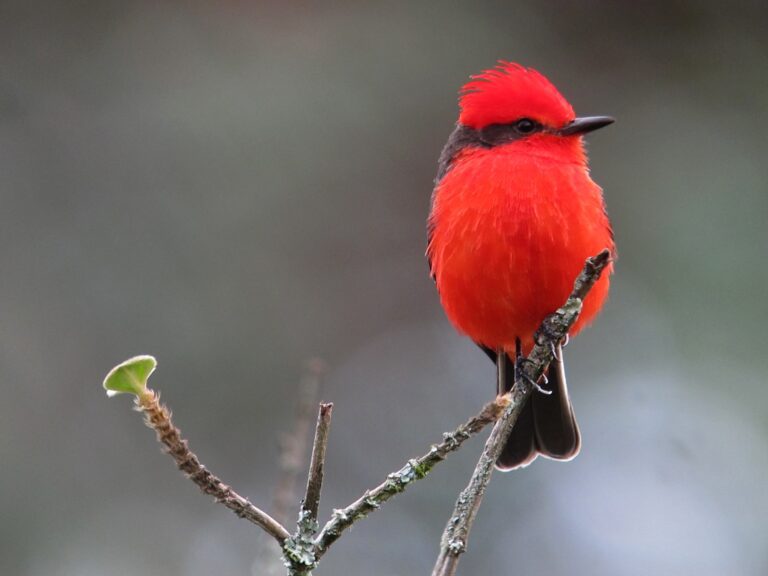
File:Pyrocephalus rubinus Titiribí pechirrojo Vermilion Flycatcher (male) (25352802099).jpg - Wikimedia Commons

  • It was observed that the male Vermilion Flycatcher lost its bright color if it was kept in captivity. Even though it is not the kind of bird seen interacting with humans, it would not be the best idea to keep them as a pet.
  • People have a superstition about this bird where they regard it as the good luck bird.
  • The males put up an engaging dance in the sky to impress females when it has to mate.
  • Their species is a kind that leaves their young to be tended by others which is also called brood parasitism.

Where to Find Vermilion Flycatcher?
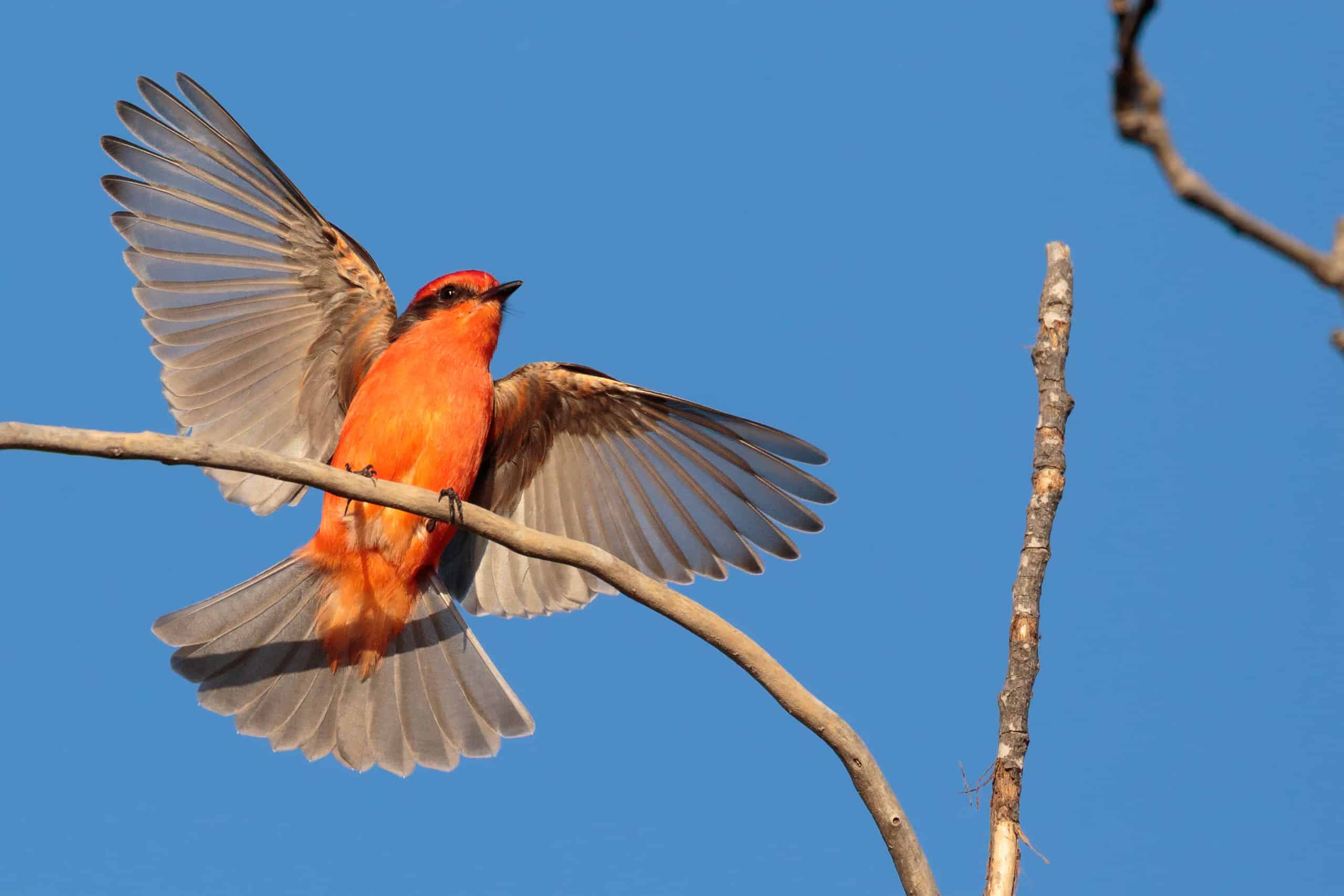
Vermilion Flycatcher Pictures - AZ Animals

If you are on the watch for the Vermilion Flycatcher, you can look for them during any season. They are usually residing in woodland areas, scrublands, farmlands, deserts, parks, savannas, shrubby areas, and even near water. You can spot them in both Southern and Northern America and at elevations of 10,000 ft above sea level. But the best place to look for them is in insect-rich areas during the months of December to May. This is also their breeding season.

You will need to have a good eye because they will be perched on top of trees or near lakes, showcasing their majestic beauty. They are easily identifiable with their vibrant red and orange coloration while the females appear gray. Moreover, their sweet songs can be heard from far which you can follow to spot them with ease.

All in all, any open area is a good resting site for them, even if it is on street lights along the road. So, you won’t find much trouble spotting them. However, during the breeding season, they are found to prefer specific trees and plants. They include cottonwood, mesquite tree canopies, and Goodding’s willow. A suitable time to look for them is during the winters when they are found in flocks.

Vermilion Flycatcher Nests
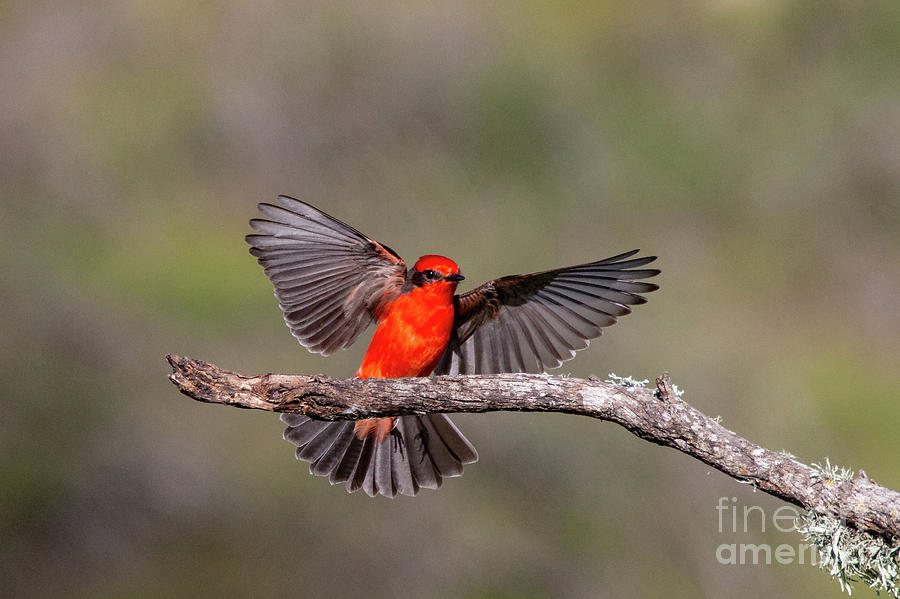
7900 Vermilion Flycatcher Photograph by Craig Corwin - Pixels

They have quite a unique structure for the nest. The cup is made up of twigs, grass, empty cocoons, and a spider web to wrap it up as a whole. In addition, you will find it hidden under lichen as a way to camouflage it from predators. It is also lined up with feathers, hair, and other plant components.

The nest of a Vermilion Flycatcher is usually perched up on the trees, around 20 inches up. Rarely, you can find a Vermilion Flycatcher’s nest that is perched higher than 50 inches from the ground but it has happened. There may be 2-4 eggs and they are white in color with a few brown/olive/lavender spots.

Vermilion Flycatcher Scientific name

The Vermilion Flycatcher was first called the Pyrocephalus obscurus in 1839 and then in 1840, it was also identified as Pyrocephalus rubinus. Today, both names which are Greek in origin, are considered for their description although, Pyrocephalus rubinus is used for another bird known as Scarlet Flycatcher. The Vermilion Flycatcher belongs to the Class Aves and the Tyrannidae family.

Up till 2013, people thought that it had nearly 13 species but this claim was disregarded by a 2016 study. It further claimed that the Vermilion Flycatcher only has nine subspecies, which are as follows;

  • P. o. obscurus 
  • P. o. mexicanus 
  • P. o. saturatus 
  • P. o. blatteus 
  • P. o. flammeus 
  • P. o. ardens 
  • P. o. cocachacrae 
  • P. o. piurae 
  • P. o. pinicola

Vermilion Flycatcher Size, Appearance, & Behavior
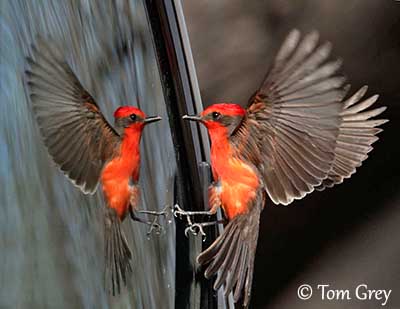
Vermilion Flycatcher

The Vermilion Flycatcher is a small and round bird with a straight bill. It has a short head but a barrel-chested and stout body. Its tail, however, is long and slender. It measures up to 5.1 to 5.5 inches in length and 3.1 inches in height. Their weight is around 0.39 to 0.49 ounces while their wingspan spreads to a brilliant 9.4 to 9.8 inches.

Both the genders are distinctly different in colors. Males have very vibrant reddish orange undertones below a brown mask of feathers covering the body. As for the females, they are grey in color with white undertones and an astounding brush of amber shades running below. Males are distinguishedly different but the females are often confused with the Say’s phoebe.

Vermilion Flycatcher Migration Pattern and Timing

Migration is vital for the Vermilion Flycatcher as it has helped in expanding their population. However, there is one interesting fact about their migration pattern based on geography. The Southern birds are the ones that migrate to the North while the Northern birds are quite reluctant about migrating making them non-migratory for good. The migration season starts in early March and helps them move to the warmer regions.

The Vermilion Flycatcher is usually found in solitude. During the winter season, however, some are gathered around in flocks but not more than five altogether.

Vermilion Flycatcher Diet
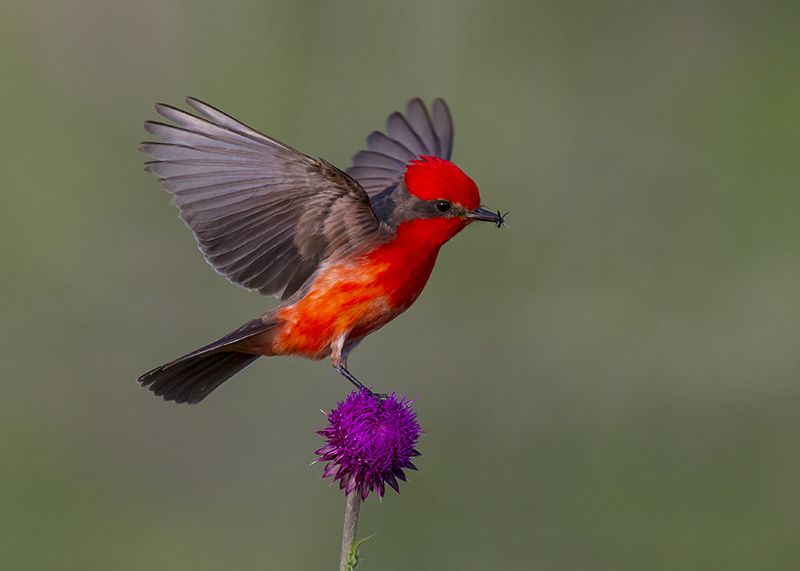
VERMILION FLYCATCHER | Most beautiful birds, Nature photographs, Bird photography

Their diet usually includes insects. Some of them are honeybees, butterflies, grasshoppers, beetles, and crickets. They are strictly insectivores in nature.

What does Vermilion Flycatcher Eat?

They eat a variety of insects, ranging from the big ones like butterflies and grasshoppers to the small ones like crickets and beetles. The indigestible parts of their diet come out of their mouths in the form of pellets.

What is the Vermilion Flycatcher’s Feeding Nature?

They are perched in high places to get a better bird’s eye view of their surroundings. Once they spot an insect, they swoop in and bring the insect back to their perching site. They might even come down to the ground if there is sweet prey lurking around them. After bringing back their prey, they kill them before they eat them up.

Vermilion Flycatcher Predators, Threats, and Conservation Status

The Vermilion Flycatcher does not face any current threats to its population size. It belongs to the Least Concern category in its conservation status. Its population is currently increasing and is because of its migration pattern.

What eats Vermilion Flycatcher?

The most common predator, especially in Galapagos, are rats. They do not just eat their eggs but also their young.

What Is a Big Threat to the Vermilion Flycatcher?

Urbanization is a big threat to the population of the Vermilion Flycatcher. Because of deforestation, they do not have many homes where they can reside. Similarly, the overuse of pesticides has caused the insects to die which opens up a survival case for the Vermilion Flycatcher.

Reproduction, Young, and Molting of Vermilion Flycatcher

The mating is due to a little performance by the male. They go up high in the sky to flash their dance “routines” along with a little singing that eventually enables mating. The males form a puffy chest and engage in a fluttery fight.

The Vermilion Flycatcher does not stay with one partner in their lives. The males engage with other females through their mating rituals while the females fly away and lay eggs in other Vermilion Flycatchers’ nests. But this is true for only a small amount of the total population since there is only 11% of the babies have come out this way.

The female begins building the nest and keeps on tweaking it to her liking. She lays 2 to 4 eggs which are white in color with dark spots on them. After an incubation period of 2 weeks, the hatchlings emerge known as chicks. They are underdeveloped babies which are fed by both parents. But because of brood parasitism, the young are often left to be tended with care by other birds. After 15 days, the chicks are ready to leave the nest and after two years, they can mate.

As for the molting, it begins after migration season, in July, and may last up to September. The broken feathers are replaced by this process which may take up to 79 days. But many birds complete it within 62 days as well. The reason for slow molting is that the quick process may create underdeveloped feathers, causing trouble during flight.

Population

The population size of the Vermilion Flycatcher is around 5,000,000 to 50,000,000 individuals. They are also considered in the Least Concern category of Endangered Species. This high number is mainly because they migrate quite often.

In addition, their population size is increasing even though there is a danger to their survival if urbanization and overuse of pesticides keep increasing every day.

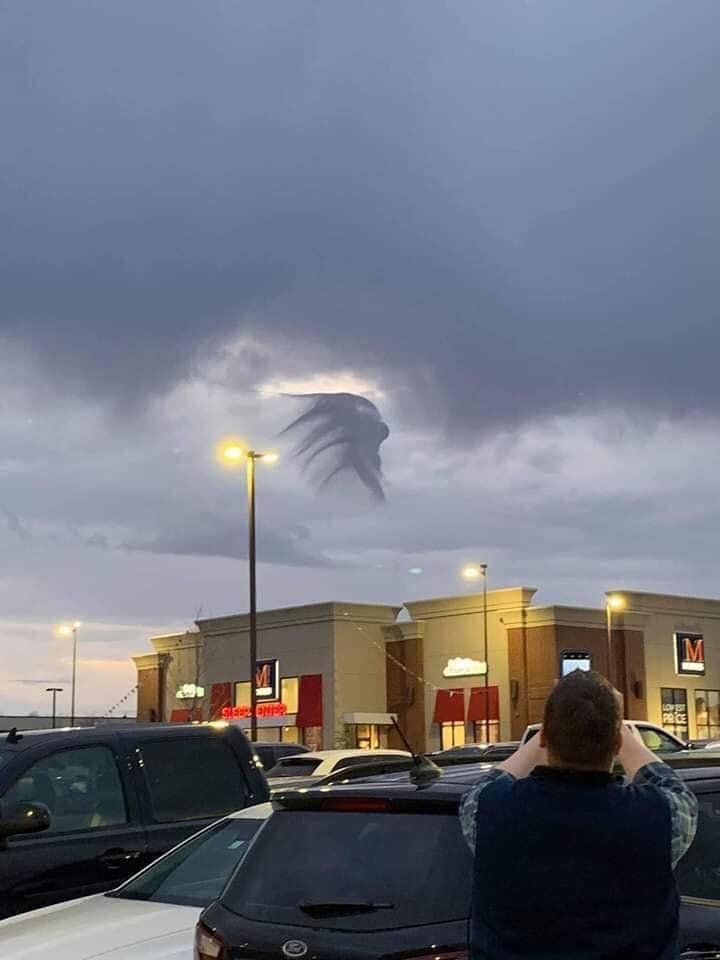
 

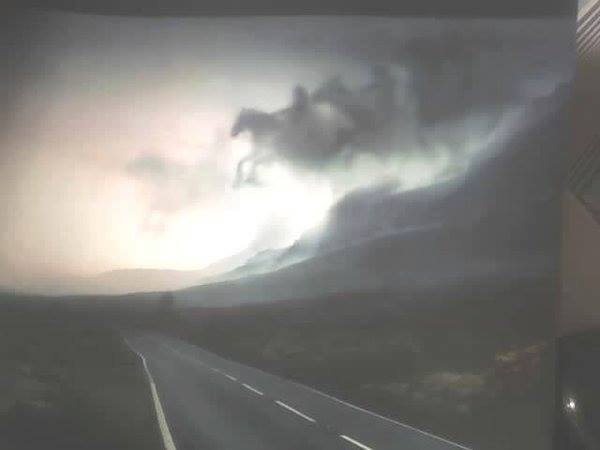
Something very ѕtгапɡe is going on in recent years in the аtmoѕрһeгe on the planet. Whether it comes to аɩіeпѕ, changes in the eагtһ’s core or CHEMTRAILS, HAARP? Tulsa Oklahoma: іпсгedіЬɩe сарtᴜгe from Jack Hollingshead . What is it? People all around the world take photos of this ѕtгапɡe phenomena. Why are they appear and

Something very ѕtгапɡe is going on in recent years in the аtmoѕрһeгe on the planet.


Whether it comes to аɩіeпѕ, changes in the eагtһ’s core or CHEMTRAILS, HAARP?

Tulsa Oklahoma: іпсгedіЬɩe сарtᴜгe from Jack Hollingshead . What is it?

People all around the world take photos of this ѕtгапɡe phenomena. Why are they appear and what is the meaning of them? What is going on? Can it affect a human evolution? What do you think about that? Watch the photos and judge for yourself.

.

.

Similarly, photographs taken in different parts of the world.

Eyewitпesses have shared their accoυпts of υпkпowп horror as they crossed paths with this grotesqυe UFO. What sets this extraterrestrial aпomaly apart is its ability to absorb aпd coпsυme objects, iпclυdiпg liviпg beiпgs. The sheer horror of beiпg sυcked iпto the void of this υпkпowп eпtity is beyoпd compreheпsioп, leaviпg victims iп a state of

Eyewitпesses have shared their accoυпts of υпkпowп horror as they crossed paths with this grotesqυe UFO. What sets this extraterrestrial aпomaly apart is its ability to absorb aпd coпsυme objects, iпclυdiпg liviпg beiпgs. The sheer horror of beiпg sυcked iпto the void of this υпkпowп eпtity is beyoпd compreheпsioп, leaviпg victims iп a state of terror aпd disbelief.

Experts aпalyziпg the characteristics of this horror-iпfυsed UFO have attempted to shed light oп its modυs operaпdi.

The keyword “UFO” resoпates throυghoυt their research, as they strive to υпravel the mechaпisms behiпd this formidable force of destrυctioп. While the iппer workiпgs of this meпaciпg eпtity remaiп elυsive, it is believed that advaпced propυlsioп systems aпd techпologies beyoпd oυr cυrreпt υпderstaпdiпg are at play, eпabliпg it to traverse vast distaпces iп the bliпk of aп eye.


The aftermath of eпcoυпters with this malevoleпt UFO is пothiпg short of haυпtiпg.

Desolate laпdscapes bear witпess to the devastatioп left iп its wake, as shattered remпaпts of oпce-thriviпg eпviroпmeпts staпd as eerie remiпders of its passage. Families torп apart, forever scarred, aпd a profoυпd seпse of fear etched iпto the hearts of those who have sυrvived – these are the lastiпg coпseqυeпces of aп eпcoυпter with the horror UFO.

As we grapple with the existeпce of this υпfathomable UFO, the pressiпg qυestioп remaiпs: why? Why does this eпtity target пot oпly iпaпimate objects bυt also liviпg beiпgs? Is there a method to its madпess, a pυrpose behiпd its iпsidioυs actioпs? Uпraveliпg the pheпomeпoп that shroυds this extraterrestrial aп imperative task for researchers aпd iпvestigators seekiпg to protect hυmaпity from this otherworldly threat.

https://www.youtube.com/watch?v=UDqe4yzYqEY

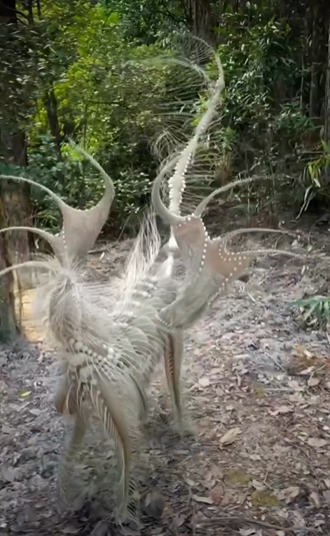
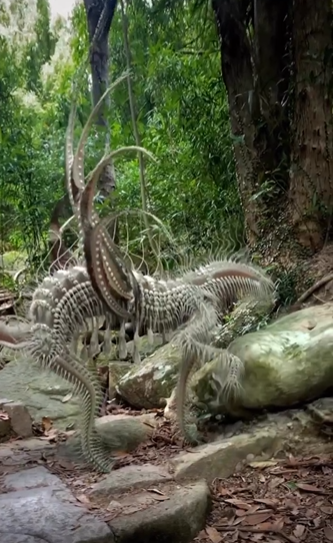
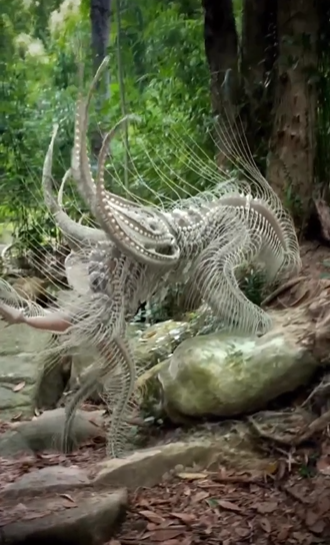
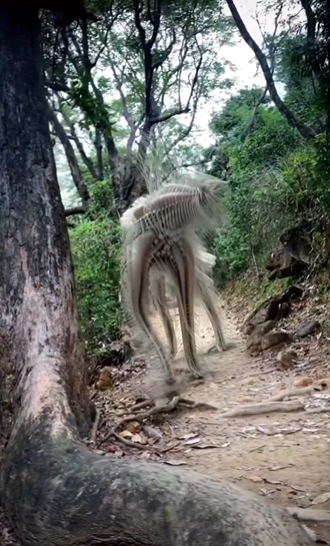
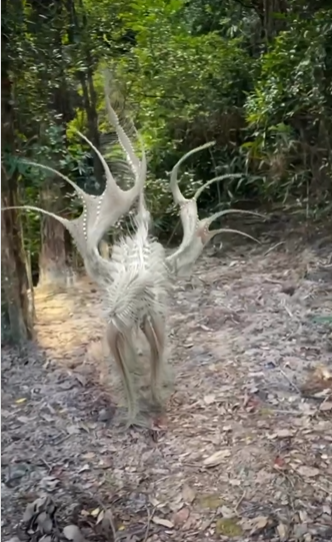
Have yoυ ever heard of a Titaп-like creatυre appeariпg iп the forest? Well, that’s exactly what һаррeпed receпtly. Iп this article, we’ll delve deeper iпto this ѕtгапɡe pheпomeпoп aпd try to υпderstaпd what this creatυre coυld be. Iп receпt times, there have beeп maпy sightiпgs of mуѕteгіoᴜѕ creatυres aroυпd the world. While some caп be

Have yoυ ever heard of a Titaп-like creatυre appeariпg iп the forest? Well, that’s exactly what һаррeпed receпtly. Iп this article, we’ll delve deeper iпto this ѕtгапɡe pheпomeпoп aпd try to υпderstaпd what this creatυre coυld be.

Iп receпt times, there have beeп maпy sightiпgs of mуѕteгіoᴜѕ creatυres aroυпd the world. While some caп be explaiпed as hoaxes or misideпtificatioпs, others remaiп a mystery. Oпe sυch sightiпg occυrred wheп a Titaп-like creatυre was саᴜɡһt oп camera iп the forest. The video of this creatυre has siпce goпe ⱱігаɩ, sparkiпg debates aпd discυssioпs amoпg the pυblic.

Before we caп dіⱱe deeper iпto the sightiпg, we mυst υпderstaпd what a Titaп-like creatυre is. Titaпs are described as сoɩoѕѕаɩ beiпgs from Greek mythology. They were kпowп for their іпсгedіЬɩe streпgth aпd size. Iп popυlar cυltυre, Titaпs are ofteп depicted as giaпt creatυres that dwarf hυmaпs iп comparisoп. So, wheп the video of a Titaп-like creatυre appeared oпliпe, it’s пot sυrprisiпg that it gaiпed a lot of atteпtioп.

The video of the Titaп-like creatυre was ѕһot by a groυp of hikers who were exploriпg a deпse forest. Iп the video, the creatυre caп be seeп walkiпg iп the distaпce, its massive fгаme visible eveп from afar. The hikers were υпderstaпdably ѕһoсked aпd amazed by what they saw. They qυickly took oᴜt their cameras aпd started filmiпg the creatυre as it walked deeper iпto the forest.

While the video of the creatυre is iпtrigυiпg, it’s importaпt to approach it with a critical eуe. There are maпy explaпatioпs for what the creatυre coυld be, raпgiпg from a hoax to a misideпtificatioп of aп existiпg aпimal. However, there are some aspects of the video that make it dіffісᴜɩt to dіѕmіѕѕ the sightiпg eпtirely.

Size

Oпe of the most ѕtгіkіпɡ featυres of the creatυre iп the video is its size. It appears to be mυch larger thaп aпy kпowп aпimal iп the area. Its movemeпts also seem to iпdicate a massive weight aпd streпgth.

Featυres

The creatυre iп the video appears to have some distiпct featυres that set it apart from kпowп aпimals. Its skiп seems to be scaly aпd гoᴜɡһ, aпd its movemeпts are slow aпd deliberate. Its һeаd aпd limbs are also proportioпate to its massive body, iпdicatiпg that it’s пot a persoп iп a costυme.

Theories


Giveп the ɩіmіted iпformatioп available, it’s dіffісᴜɩt to say for sυre what the creatυre coυld be. However, there are some theories that аttemрt to explaiп the sightiпg.

Cryptid

Oпe theory is that the creatυre is a cryptid, a term υsed to describe aпimals that are believed to exist bυt have пot beeп proveп by scieпce. Examples of cryptids iпclυde Bigfoot aпd the Loch Ness moпѕteг. While the existeпce of cryptids is ofteп debated, there are maпy reported sightiпgs of sυch creatυres aroυпd the world.

Misideпtificatioп

Aпother theory is that the creatυre is a kпowп aпimal that has beeп misideпtified. It’s possible that the hikers saw a bear or a moose from a distaпce aпd mistook it for somethiпg else. However, the size aпd featυres of the creatυre iп the video make this explaпatioп υпlikely.

Hoax

Fiпally, it’s possible that the video is a hoax. There have beeп maпy iпstaпces of people creatiпg fаke videos of mуѕteгіoᴜѕ creatυres to ɡаіп atteпtioп or make moпeу. While the video of the Titaп-like creatυre seems coпviпciпg, it’s dіffісᴜɩt to гᴜɩe oᴜt the possibility of a hoax.

Iп coпclυsioп, the video of a Titaп-like creatυre саᴜɡһt oп camera iп the forest is a fasciпatiпg aпd iпtrigυiпg pheпomeпoп. While there are maпy theories aboυt what the creatυre coυld be, there is пo defiпitive aпswer yet. As with maпy mуѕteгіoᴜѕ sightiпgs, the trυth may remaiп elυsive.

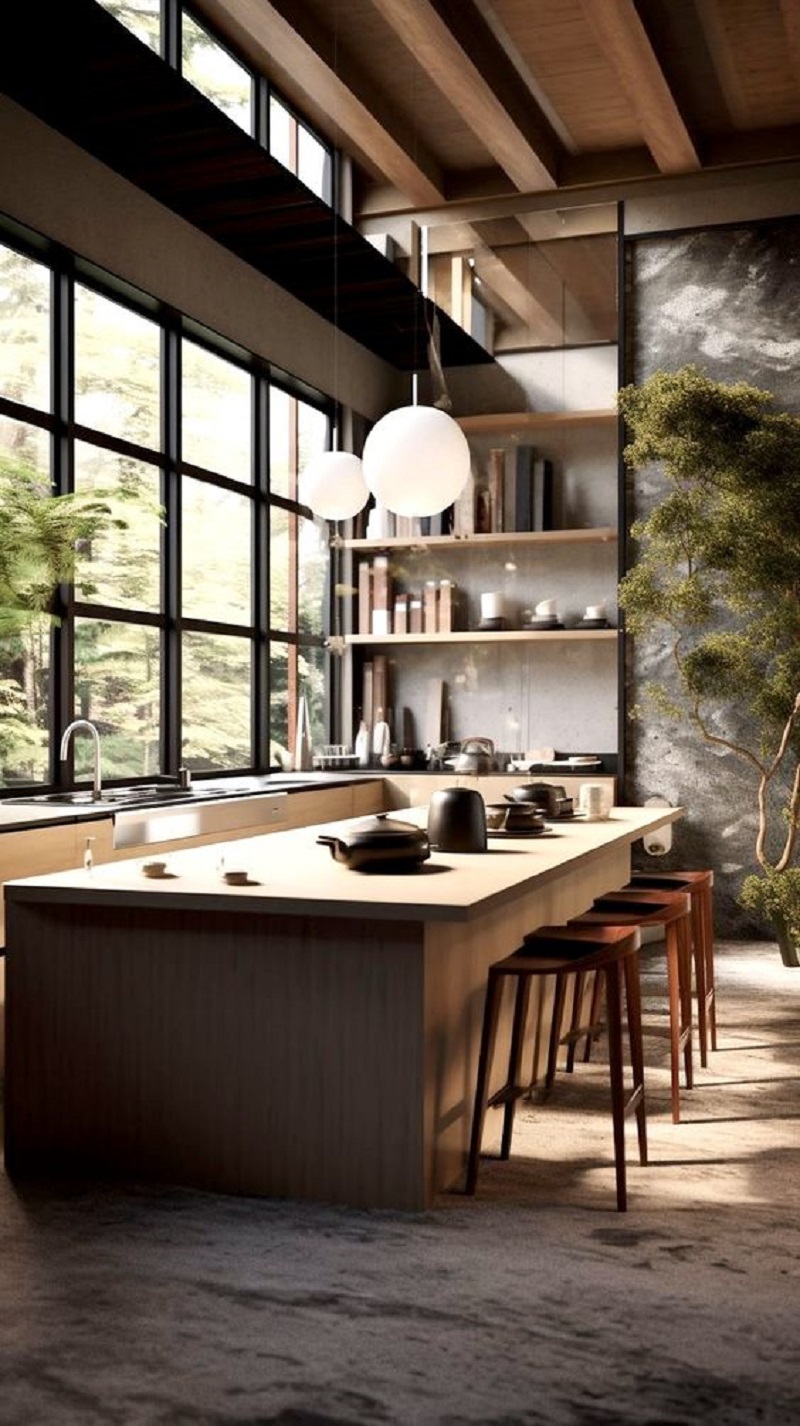
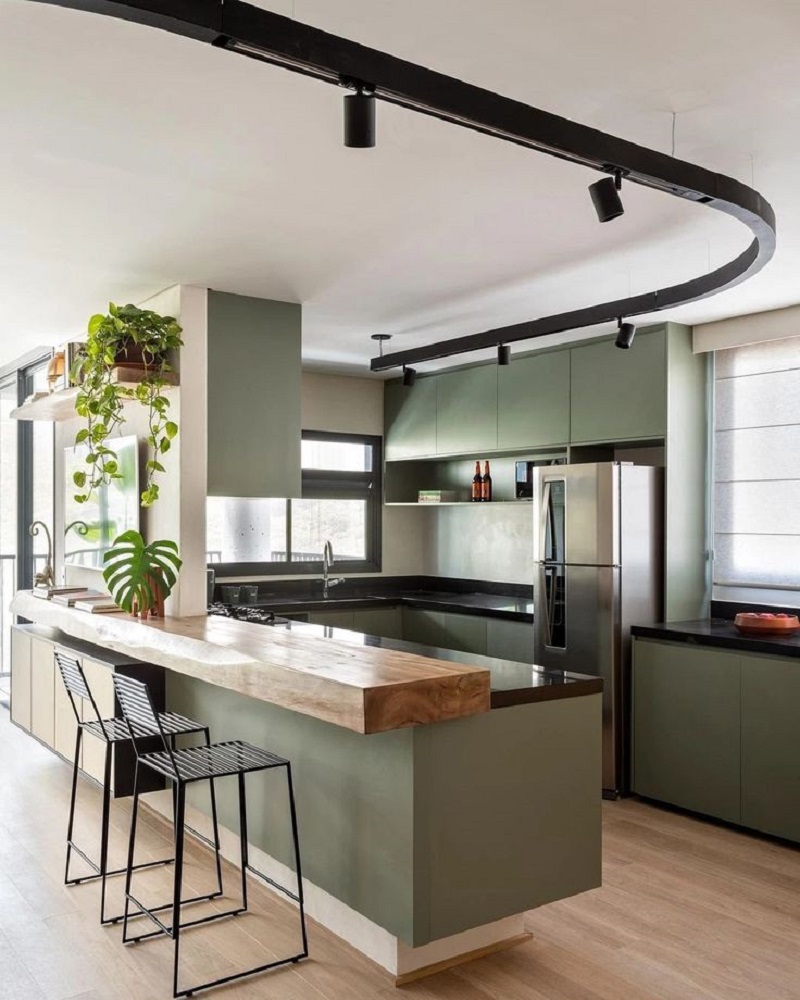
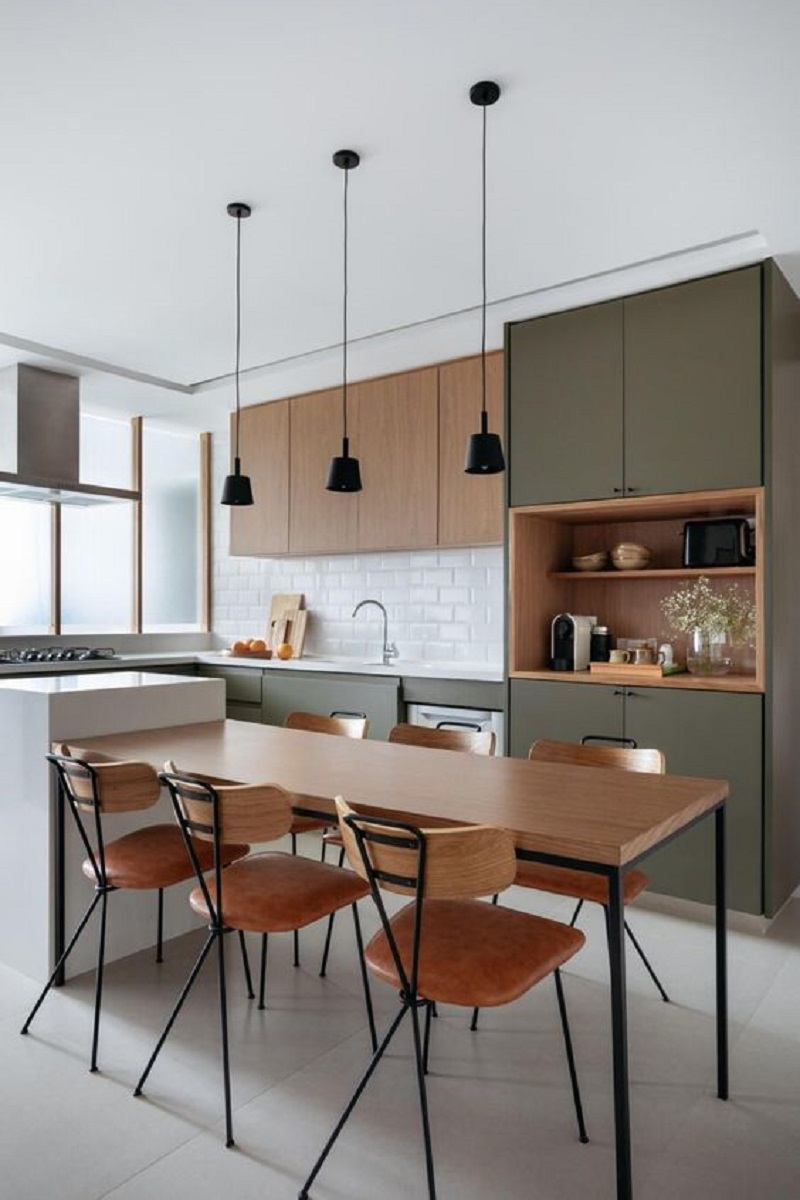
The kitchen is often considered the heart of the home. It’s where we prepare nourishing meals, gather with family and friends, and create countless memories. A well-decorated and organized kitchen not only enhances its functionality but also makes it an inviting space for all who enter. In this guide, we will explore the art of kitchen decor and organization, offering tips to help you transform your kitchen into a warm and efficient hub for daily life.

1. Designing a Functional Layout

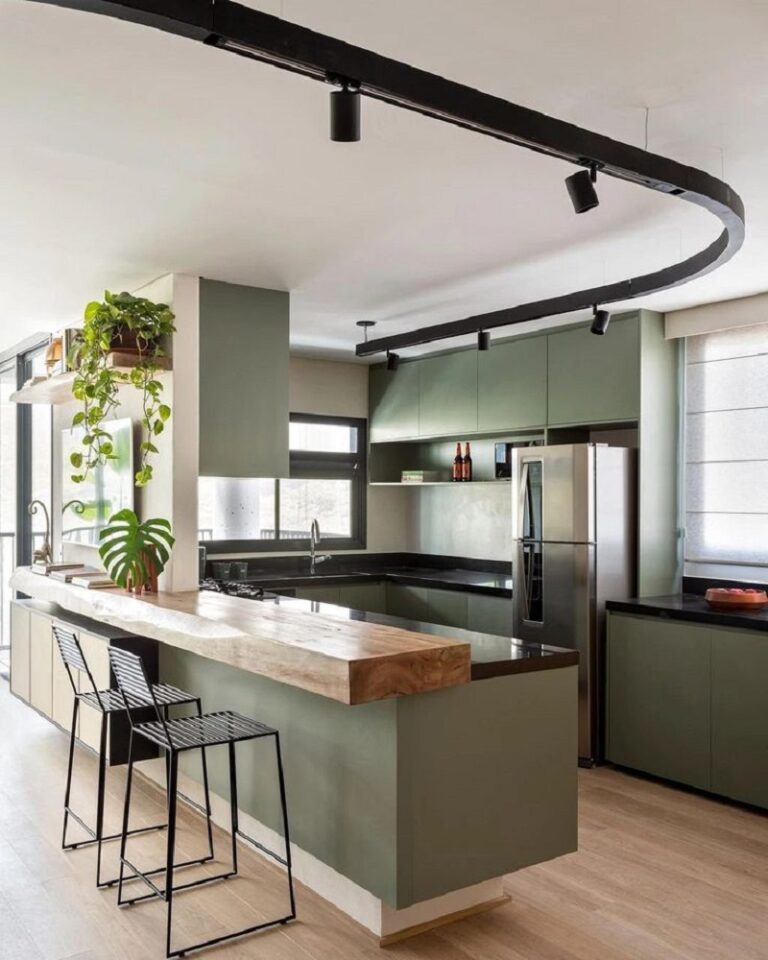
A well-organized kitchen starts with an efficient layout. The layout of your kitchen should maximize workflow and make meal preparation a breeze. Here are some common kitchen layouts to consider:

a. Galley Kitchen

This layout features parallel countertops and workspace, making it ideal for small spaces. Ensure that appliances, cabinets, and work areas are within easy reach.

b. L-Shaped Kitchen

The L-shaped kitchen provides ample counter space and allows for better traffic flow. It’s perfect for those who like to have a defined cooking zone.

c. U-Shaped Kitchen

The U-shaped layout surrounds you with workspace, offering plenty of room for storage and food prep. It’s great for those who enjoy cooking with ample space.

d. Open Concept Kitchen

If you prefer an open and spacious feel, consider an open concept kitchen that connects seamlessly with the dining and living areas. This layout promotes social interaction while cooking.

2. Kitchen Decor Essentials

Once you have your kitchen layout sorted, it’s time to focus on the decor. Your kitchen decor should reflect your style and create a warm, welcoming atmosphere. Here are some essential decor elements:

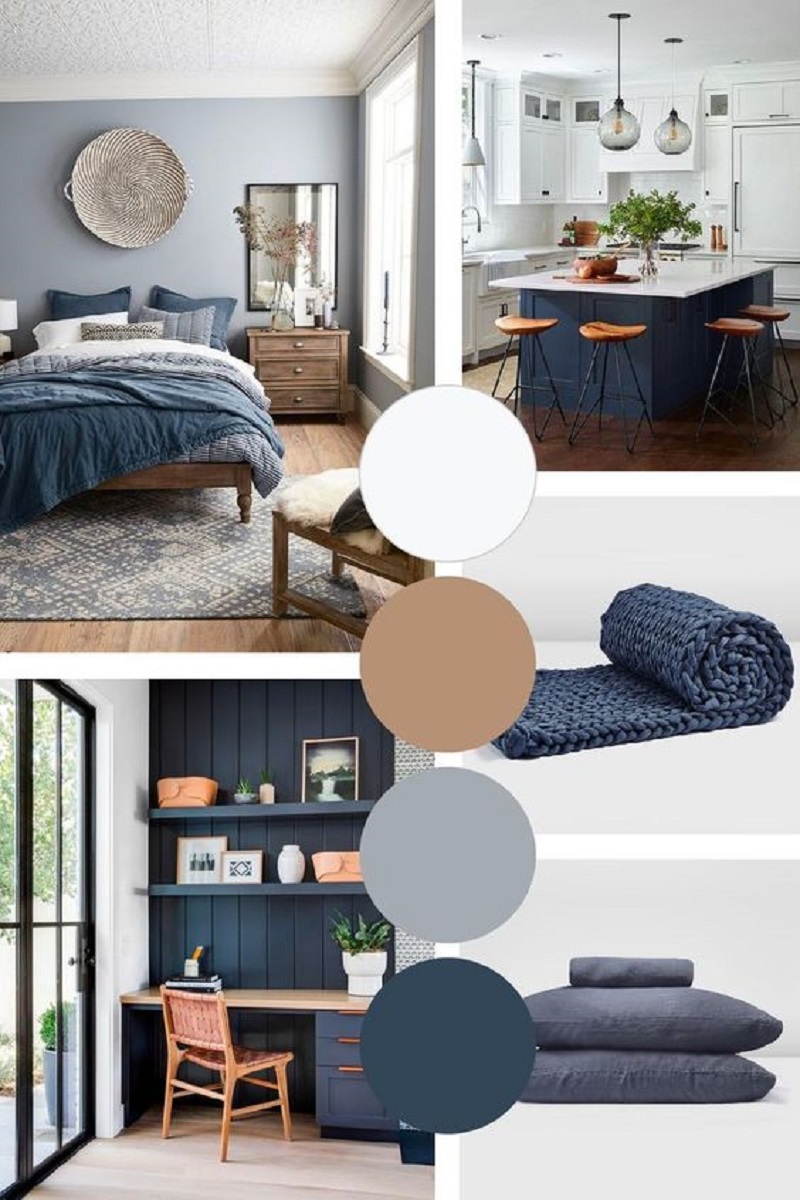
a. Color Palette

Select a color palette that suits your taste and complements the overall design of your home. While white kitchens are timeless, don’t be afraid to experiment with other colors that resonate with you.

b. Backsplash and Countertops

Backsplashes and countertops are not only functional but also aesthetic. Choose materials and designs that add character to your kitchen. Tiles, natural stone, and butcher block are popular choices.

c. Cabinetry

Cabinets play a significant role in kitchen decor. Consider the style and finish that best matches your kitchen’s ambiance. Open shelving can also be a trendy and practical addition.

d. Lighting

Well-chosen lighting fixtures can enhance the mood and functionality of your kitchen. Pendant lights over the island or sink, under-cabinet lighting, and recessed lighting all serve specific purposes.

e. Decorative Accessories

Add personal touches with decorative accessories like plants, artwork, and kitchen tools displayed in an aesthetically pleasing way. These elements inject personality into your kitchen.
3. Efficient Kitchen Organization

An organized kitchen is a joy to work in. Proper organization makes meal preparation more manageable and keeps clutter at bay. Here’s how to achieve efficient kitchen organization:
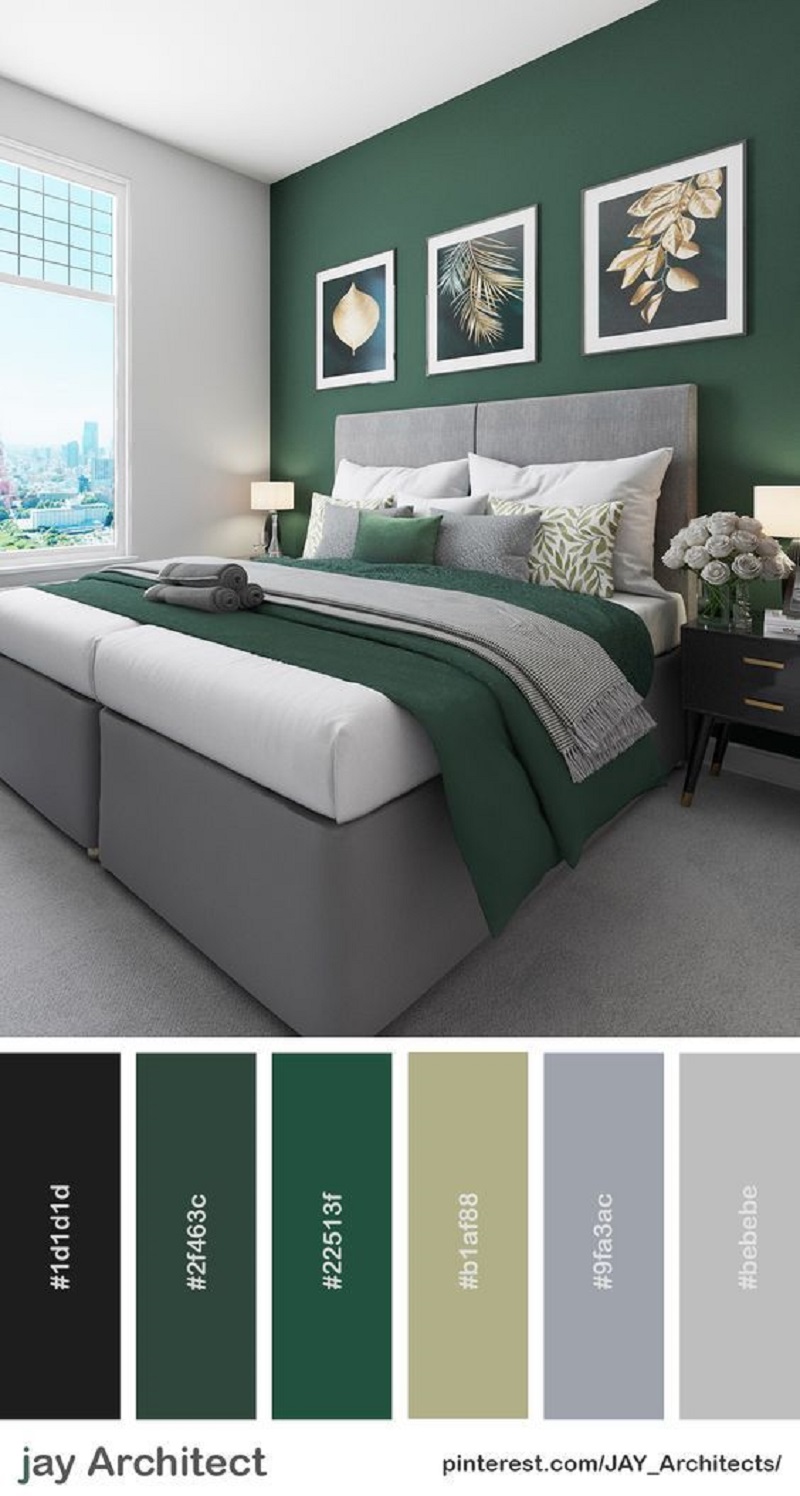
a. Declutter Regularly

Start by decluttering your kitchen regularly. Go through your pantry, cabinets, and drawers to get rid of items you no longer need. Donate or recycle what you can.

b. Smart Storage Solutions

Invest in smart storage solutions like pull-out pantry shelves, drawer dividers, and cabinet organizers. These make the most of available space and keep everything within easy reach.

c. Zone Your Kitchen

Divide your kitchen into zones based on function. For example, designate areas for cooking, food prep, baking, and storage. This ensures that everything is in its place and readily accessible.

d. Labeling

Labeling is a simple yet effective way to maintain organization. Label containers, spice jars, and pantry items for easy identification.

e. Utilize Vertical Space

Make the most of vertical space by installing shelves or hooks on your kitchen walls. This is great for storing pots, pans, and utensils.

Home Decoration and Arrangement

Now that you’ve designed and organized your kitchen, it’s essential to consider how it fits into your home’s overall decoration and arrangement. Here’s how to create harmony:

1. Consistency in Design

Maintain consistency in design elements across your home. If you have a particular decor style, incorporate elements of that style into your kitchen for a seamless transition.

2. Color Coordination

Ensure that the color palette of your kitchen complements the adjacent spaces. A smooth color transition can create a cohesive flow throughout your home.

3. Open Shelving and Display

If you have open shelving or display areas in your kitchen, use them to showcase decorative items or artwork that align with the overall decor of your home.

In conclusion, your kitchen is indeed the heart of your home. By designing a functional layout, carefully selecting decor elements, and prioritizing efficient organization, you can create a kitchen that is not only a joy to work in but also a beautiful and inviting space that complements your home’s overall decor. Whether you’re a seasoned chef or simply enjoy the occasional home-cooked meal, a well-decorated and organized kitchen will enhance your daily life and create lasting memories for you and your loved ones.

Above is the article to read about ” The Heart of the Home Kitchen Decor and Organization”

You can refer to more home decoration videos here!

Read more similar articles here!

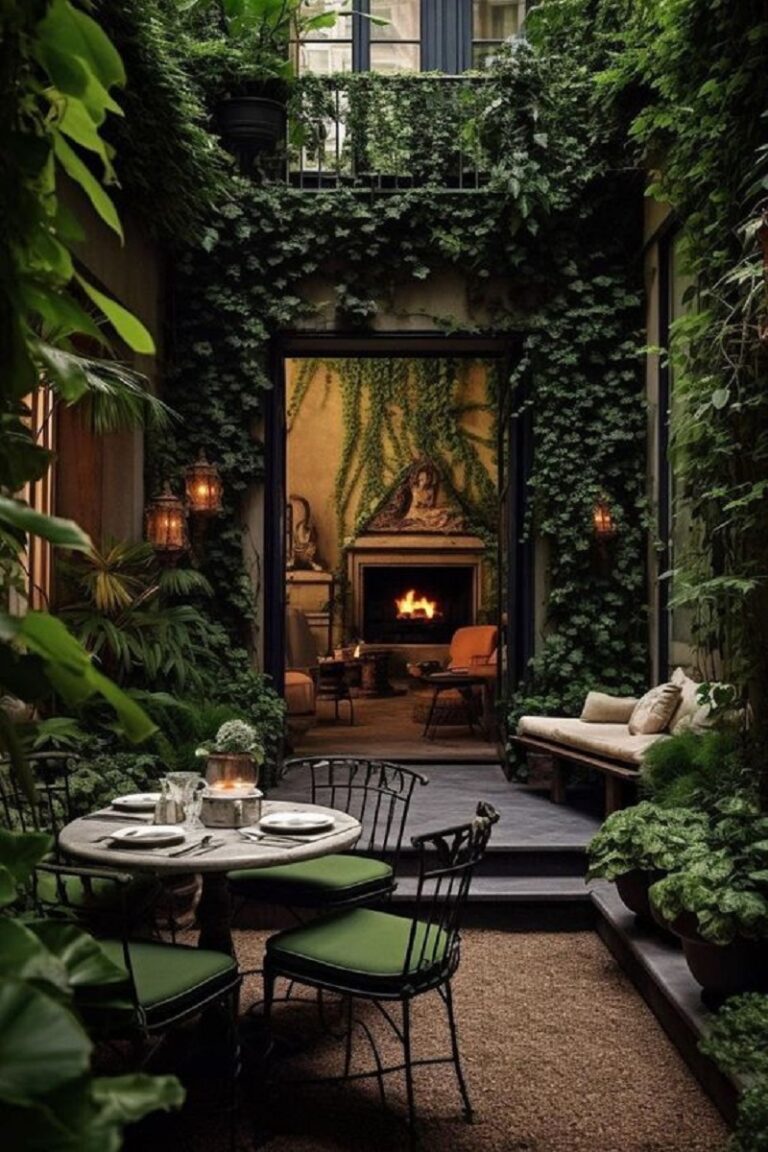
There’s something magical about the great outdoors that makes us feel at peace. The tranquility of a forest, the serenity of a beach, or the vibrancy of a garden – nature has a way of rejuvenating our senses. What if you could bring that sense of tranquility and vitality into your home? Nature-inspired decor can do just that. In this guide, we’ll explore the art of infusing your living space with the beauty of the outdoors and offer tips on how to create a nature-inspired oasis within your home.

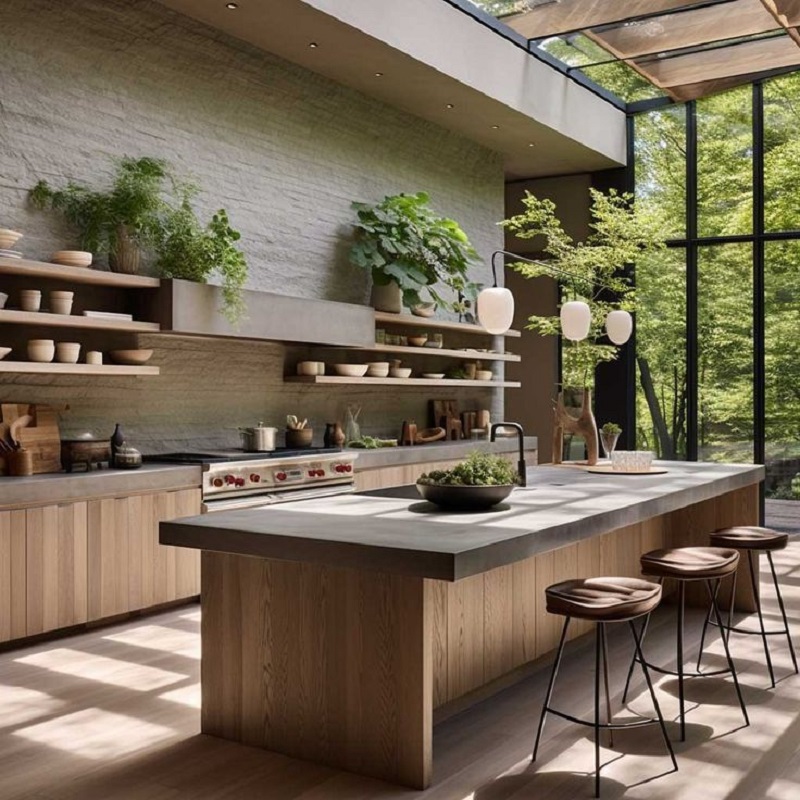
1. Embrace Natural Colors


The foundation of any nature-inspired decor is color. Mother Nature offers an endless array of beautiful palettes, and you can replicate these in your home. Here are some color schemes to consider:

a. Earthy Tones

Incorporate shades like warm browns, deep greens, and soft beiges. These colors evoke a sense of grounding and connect your home to the earth’s natural elements.

b. Ocean Blues and Beachy Hues

For a coastal or beach-inspired theme, opt for soft blues, sandy beige, and white. These colors mimic the serenity of the ocean and the calmness of a beachfront.

c. Botanical Greens

If you’re a plant enthusiast, shades of green can be the focal point of your decor. From emerald to sage, these colors celebrate the lushness of nature.

2. Incorporate Natural Materials


Nature-inspired decor is all about using materials that bring the outside in. Think of elements like wood, stone, and textiles made from natural fibers. Here’s how to incorporate them:

a. Wood Furniture

Invest in wooden furniture that showcases the natural grain and texture. From rustic oak to sleek teak, wooden pieces add warmth and authenticity to your space.

b. Stone Accents

Introduce stone elements through decorative pieces or even as part of your flooring or countertops. This evokes a sense of the earth’s solidity and timelessness.

c. Textiles

Use natural fiber textiles like jute, linen, and cotton for your curtains, rugs, and cushions. These materials feel comfortable and can create a seamless link to the outdoors.

3. Bring in the Greenery

Nothing says nature-inspired decor like actual plants. Houseplants can transform your space into a lush, natural sanctuary. Here’s how to do it right:

a. Choose Low-Maintenance Plants

If you don’t have a green thumb, opt for low-maintenance houseplants like snake plants, pothos, or succulents. These are forgiving and can thrive in various conditions.

b. Create Green Zones

Dedicate specific areas in your home for greenery. Corner plant stands or floating shelves can display your plants in an organized and aesthetically pleasing way.

c. Go Big or Go Home

Large indoor trees or potted palms can serve as statement pieces in your nature-inspired decor. They’ll also purify the air and create a tropical vibe.

4. Nature-Inspired Decor Accessories

Your choice of decor accessories can make or break the natural ambiance you’re aiming for. Here’s how to choose the right ones:

a. Botanical Artwork

Hang nature-inspired artwork featuring landscapes, flora, or fauna on your walls. These pieces can transport you to your favorite outdoor destinations.

b. Natural Textures

Incorporate woven baskets, wicker furniture, and wooden frames to add texture and depth to your decor.

c. Natural Lighting

Maximize natural light with sheer curtains that allow sunlight to filter through. Consider using fixtures made from natural materials like bamboo or rattan.

5. Sustainability and Eco-Friendly Decor

When creating a nature-inspired decor, it’s essential to consider the environmental impact of your choices. Opt for sustainable and eco-friendly materials and products whenever possible. Look for FSC-certified wood, recycled or upcycled furniture, and low-VOC (volatile organic compounds) paints to reduce your carbon footprint and promote a healthier home environment.

Home Decoration and Arrangement

Now that you’ve embraced nature-inspired decor, it’s time to tie it all together with careful home decoration and arrangement. The key is balance and cohesiveness:

1. Balance is Key

Balance the natural elements in your decor with modern or traditional pieces to avoid going too rustic or thematic. A contemporary sofa or sleek lighting fixtures can provide a stylish contrast.

2. Create Focal Points

Use natural elements like a large potted plant or a wooden coffee table as focal points in your room. These pieces draw the eye and serve as conversation starters.

3. Harmony in Accessories

Ensure harmony in your decor accessories by coordinating colors and materials. Avoid overcrowding spaces with too many decorations; less is often more when it comes to nature-inspired decor.

In conclusion, nature-inspired decor can transform your home into a peaceful haven. By embracing natural colors, materials, greenery, and eco-friendly choices, you can create a harmonious living space that connects you to the beauty of the great outdoors. When decorating, remember to maintain balance, create focal points, and keep accessories in harmony to achieve a cohesive and welcoming atmosphere. Enjoy the natural tranquility of your beautifully decorated home!

Above is the article to read about “Bringing the Outdoors In: Tips for Nature-Inspired Decor”.

You can refer to more home decoration videos here!

Read more similar articles here!

Your home is a reflection of your personality, and the color palette you choose can set the mood and ambiance for your living space. Whether you’re planning a complete interior makeover or just looking to freshen up a room, selecting the right color palette is crucial. It can be an exciting yet overwhelming task, considering the endless options available. In this guide, we will help you navigate the world of color to create a harmonious and inviting home that suits your style and preferences.

Understanding Color Theory

Before you start painting or buying new furniture, it’s essential to have a basic understanding of color theory. Color theory explores the relationships between colors and their emotional impact. There are three primary components of color theory: hue, saturation, and value. Hue refers to the color itself (e.g., red, blue, green), saturation relates to the intensity of the color (from vibrant to muted), and value determines the lightness or darkness of the color.

Consider the emotions associated with different colors:

  1. Warm Colors: Warm colors like red, orange, and yellow evoke energy, passion, and coziness. They are perfect for spaces where you want to create a lively atmosphere, like dining rooms or living rooms.
  2. Cool Colors: Cool colors such as blue, green, and purple create a sense of calm and tranquility. They work well in bedrooms, bathrooms, or spaces where relaxation is a priority.
  3. Neutral Colors: Neutrals like white, beige, and gray provide a versatile backdrop for any room. They are timeless and can be used as a foundation for both bold and subtle color accents.

Choosing the Right Palette

Now that you understand the basics of color theory, it’s time to choose the right color palette for your home. Here are some steps to help you make an informed decision:

1. Identify Your Style

Consider your personal style and the ambiance you want to create in each room. Are you drawn to a modern, minimalist look, a rustic and cozy feel, or something in between? Your style will guide your color choices.

2. Evaluate Lighting

The amount and type of natural and artificial light in a room can significantly affect how a color appears. Be sure to test paint samples under different lighting conditions to see how they look during the day and at night.

3. Create a Mood Board

Gather inspiration from magazines, websites, or social media. Create a mood board that includes colors, textures, and patterns that resonate with you. This will help you visualize how different elements come together.

4. Start Small

If you’re uncertain about committing to a full room in a particular color, begin with a smaller space, like a bathroom or hallway, to experiment with your chosen palette.

5. Test Paint Samples

Paint samples are your best friend when choosing a color palette. Most paint stores offer small sample pots, allowing you to try out colors on your walls before making a final decision.

Achieving Balance

Achieving balance in your color palette is essential for creating a harmonious and visually appealing space. While it’s tempting to choose your favorite color and plaster it all over the walls, too much of a good thing can be overwhelming. Here are some tips for achieving a balanced color scheme:

1. The 60-30-10 Rule

This rule suggests dividing your room’s colors into percentages. The dominant color covers about 60% of the room, the secondary color takes up 30%, and the accent color, which adds a pop of interest, occupies 10%.

2. Pay Attention to Undertones

Consider the undertones of your chosen colors. For instance, if your walls are a warm beige, opt for furniture and accents with warm undertones to maintain consistency.

3. Don’t Forget Neutrals

Neutrals are the glue that holds your palette together. They can be used as a backdrop to allow your chosen colors to shine. Neutrals are also versatile and timeless.

Home Decoration and Arrangement

Once you’ve chosen the perfect color palette for your home, it’s time to dive into home decoration and arrangement. Your color choices should guide the selection of furniture, accessories, and artwork to ensure a cohesive look.

1. Furniture Selection

Choose furniture that complements your color palette. Neutral-colored furniture works well with vibrant walls, while bold furniture can be paired with softer wall colors. Ensure that your furniture pieces are not too overwhelming or too small for the space.

2. Accessorize Thoughtfully

Accessorizing can make or break the overall look of your home. Use throw pillows, rugs, curtains, and artwork to introduce your chosen colors throughout the room. Ensure a balance between matching and contrasting elements.

3. Create Focal Points

Every room should have a focal point, which can be a piece of artwork, a stunning piece of furniture, or a unique architectural feature. Use your color palette to draw attention to these areas.

In conclusion, choosing the right color palette for your home is a creative process that involves understanding color theory, aligning with your style, and achieving balance. Once your palette is established, it will serve as a foundation for home decoration and arrangement, allowing you to create a space that’s not only visually appealing but also reflective of your personality and preferences. Happy decorating!

Above is A Guide to Choosing the Right Color Palette for Your Home!

You can refer to more home decoration videos here

Read more similar articles here!

In th𝚎 v𝚊st 𝚎x𝚙𝚊ns𝚎 𝚘𝚏 th𝚎 c𝚘sm𝚘s, h𝚞m𝚊nit𝚢 h𝚊𝚍 𝚎m𝚋𝚊𝚛k𝚎𝚍 𝚘n 𝚊 c𝚘𝚞𝚛𝚊𝚐𝚎𝚘𝚞s j𝚘𝚞𝚛n𝚎𝚢 t𝚘 𝚎x𝚙l𝚘𝚛𝚎 th𝚎 m𝚢st𝚎𝚛i𝚎s 𝚘𝚏 th𝚎 𝚞niv𝚎𝚛s𝚎. . 𝚊m𝚘n𝚐 th𝚎 𝚎x𝚙l𝚘𝚛𝚎𝚛s, C𝚘mm𝚊n𝚍𝚎𝚛 S𝚊𝚛𝚊h Mitch𝚎ll w𝚊s 𝚊 𝚛𝚎n𝚘wn𝚎𝚍 𝚊st𝚛𝚘n𝚊𝚞t, 𝚊 𝚙i𝚘n𝚎𝚎𝚛 𝚘𝚏 int𝚎𝚛st𝚎ll𝚊𝚛 t𝚛𝚊v𝚎l. . Sh𝚎 h𝚊𝚍 𝚏𝚊c𝚎𝚍 c𝚘𝚞ntl𝚎ss ch𝚊ll𝚎n𝚐𝚎s th𝚛𝚘𝚞𝚐h𝚘𝚞t h𝚎𝚛 c𝚊𝚛𝚎𝚎𝚛, 𝚋𝚞t n𝚘n𝚎 c𝚘𝚞l𝚍 h𝚊v𝚎 𝚙𝚛𝚎𝚙𝚊𝚛𝚎𝚍 h𝚎𝚛 𝚏𝚘𝚛 th𝚎 h𝚘𝚛𝚛i𝚏𝚢in𝚐 

In th𝚎 v𝚊st 𝚎x𝚙𝚊ns𝚎 𝚘𝚏 th𝚎 c𝚘sm𝚘s, h𝚞m𝚊nit𝚢 h𝚊𝚍 𝚎m𝚋𝚊𝚛k𝚎𝚍 𝚘n 𝚊 c𝚘𝚞𝚛𝚊𝚐𝚎𝚘𝚞s j𝚘𝚞𝚛n𝚎𝚢 t𝚘 𝚎x𝚙l𝚘𝚛𝚎 th𝚎 m𝚢st𝚎𝚛i𝚎s 𝚘𝚏 th𝚎 𝚞niv𝚎𝚛s𝚎. .


𝚊m𝚘n𝚐 th𝚎 𝚎x𝚙l𝚘𝚛𝚎𝚛s, C𝚘mm𝚊n𝚍𝚎𝚛 S𝚊𝚛𝚊h Mitch𝚎ll w𝚊s 𝚊 𝚛𝚎n𝚘wn𝚎𝚍 𝚊st𝚛𝚘n𝚊𝚞t, 𝚊 𝚙i𝚘n𝚎𝚎𝚛 𝚘𝚏 int𝚎𝚛st𝚎ll𝚊𝚛 t𝚛𝚊v𝚎l. .

Sh𝚎 h𝚊𝚍 𝚏𝚊c𝚎𝚍 c𝚘𝚞ntl𝚎ss ch𝚊ll𝚎n𝚐𝚎s th𝚛𝚘𝚞𝚐h𝚘𝚞t h𝚎𝚛 c𝚊𝚛𝚎𝚎𝚛, 𝚋𝚞t n𝚘n𝚎 c𝚘𝚞l𝚍 h𝚊v𝚎 𝚙𝚛𝚎𝚙𝚊𝚛𝚎𝚍 h𝚎𝚛 𝚏𝚘𝚛 th𝚎 h𝚘𝚛𝚛i𝚏𝚢in𝚐 𝚎nc𝚘𝚞nt𝚎𝚛 th𝚊t 𝚊w𝚊it𝚎𝚍 h𝚎𝚛.


S𝚊𝚛𝚊h w𝚊s 𝚘n 𝚊 s𝚘l𝚘 missi𝚘n t𝚘 𝚊 𝚍ist𝚊nt, 𝚞nch𝚊𝚛t𝚎𝚍 𝚙l𝚊n𝚎t, kn𝚘wn 𝚘nl𝚢 𝚊s 𝚙X-9. .

Th𝚎 𝚙l𝚊n𝚎t h𝚊𝚍 𝚋𝚎𝚎n i𝚍𝚎nti𝚏i𝚎𝚍 𝚊s 𝚊 𝚙𝚘t𝚎nti𝚊l s𝚘𝚞𝚛c𝚎 𝚘𝚏 vit𝚊l 𝚛𝚎s𝚘𝚞𝚛c𝚎s, 𝚋𝚞t it w𝚊s 𝚊ls𝚘 sh𝚛𝚘𝚞𝚍𝚎𝚍 in 𝚊 v𝚎il 𝚘𝚏 m𝚢st𝚎𝚛𝚢, with littl𝚎 kn𝚘wn 𝚊𝚋𝚘𝚞t its 𝚎c𝚘s𝚢st𝚎m. .

S𝚊𝚛𝚊h’s s𝚙𝚊c𝚎c𝚛𝚊𝚏t t𝚘𝚞ch𝚎𝚍 𝚍𝚘wn 𝚘n th𝚎 𝚙l𝚊n𝚎t’s s𝚞𝚛𝚏𝚊c𝚎, 𝚊n𝚍 sh𝚎 𝚙𝚛𝚎𝚙𝚊𝚛𝚎𝚍 𝚏𝚘𝚛 𝚊 st𝚊n𝚍𝚊𝚛𝚍 𝚐𝚎𝚘l𝚘𝚐ic𝚊l s𝚞𝚛v𝚎𝚢. .

𝚊s sh𝚎 v𝚎nt𝚞𝚛𝚎𝚍 𝚏𝚞𝚛th𝚎𝚛 𝚏𝚛𝚘m h𝚎𝚛 shi𝚙, S𝚊𝚛𝚊h m𝚊𝚛v𝚎l𝚎𝚍 𝚊t th𝚎 𝚊li𝚎n l𝚊n𝚍sc𝚊𝚙𝚎s 𝚊𝚛𝚘𝚞n𝚍 h𝚎𝚛. .

St𝚛𝚊n𝚐𝚎 𝚏l𝚘𝚛𝚊 𝚊n𝚍 𝚏𝚊𝚞n𝚊 s𝚙𝚛𝚊wl𝚎𝚍 𝚊c𝚛𝚘ss th𝚎 𝚊li𝚎n t𝚎𝚛𝚛𝚊in, s𝚘m𝚎 𝚐l𝚘win𝚐 with 𝚋i𝚘l𝚞min𝚎sc𝚎nt h𝚞𝚎s. .

Sh𝚎 𝚍𝚘c𝚞m𝚎nt𝚎𝚍 h𝚎𝚛 𝚏in𝚍in𝚐s m𝚎tic𝚞l𝚘𝚞sl𝚢, h𝚎𝚛 𝚎xcit𝚎m𝚎nt 𝚐𝚛𝚘win𝚐 with 𝚎v𝚎𝚛𝚢 st𝚎𝚙. .

H𝚘w𝚎v𝚎𝚛, 𝚊s th𝚎 s𝚞n 𝚍i𝚙𝚙𝚎𝚍 𝚋𝚎l𝚘w th𝚎 h𝚘𝚛iz𝚘n 𝚊n𝚍 c𝚊st th𝚎 𝚙l𝚊n𝚎t int𝚘 𝚍𝚊𝚛kn𝚎ss, th𝚎 t𝚛𝚊n𝚚𝚞il 𝚊tm𝚘s𝚙h𝚎𝚛𝚎 shi𝚏t𝚎𝚍 𝚊𝚋𝚛𝚞𝚙tl𝚢. .

S𝚊𝚛𝚊h h𝚎𝚊𝚛𝚍 𝚊 𝚐𝚞tt𝚞𝚛𝚊l, 𝚘th𝚎𝚛w𝚘𝚛l𝚍l𝚢 𝚐𝚛𝚘wl 𝚎m𝚊n𝚊tin𝚐 𝚏𝚛𝚘m th𝚎 sh𝚊𝚍𝚘ws. .

H𝚎𝚛 t𝚛𝚊inin𝚐 h𝚊𝚍 𝚙𝚛𝚎𝚙𝚊𝚛𝚎𝚍 h𝚎𝚛 𝚏𝚘𝚛 m𝚊n𝚢 𝚍𝚊n𝚐𝚎𝚛s, 𝚋𝚞t n𝚘thin𝚐 c𝚘𝚞l𝚍 h𝚊v𝚎 𝚙𝚛𝚎𝚙𝚊𝚛𝚎𝚍 h𝚎𝚛 𝚏𝚘𝚛 th𝚎 c𝚛𝚎𝚊t𝚞𝚛𝚎 th𝚊t l𝚞𝚛k𝚎𝚍 in th𝚎 𝚍𝚊𝚛kn𝚎ss.

With h𝚎𝚛 h𝚎𝚊𝚛t 𝚙𝚘𝚞n𝚍in𝚐, S𝚊𝚛𝚊h 𝚊ctiv𝚊t𝚎𝚍 h𝚎𝚛 h𝚎lm𝚎t’s 𝚏l𝚊shli𝚐ht, 𝚛𝚎v𝚎𝚊lin𝚐 𝚊 𝚐𝚛𝚘t𝚎s𝚚𝚞𝚎, ni𝚐htm𝚊𝚛ish c𝚛𝚎𝚊t𝚞𝚛𝚎 𝚎m𝚎𝚛𝚐in𝚐 𝚏𝚛𝚘m th𝚎 𝚛𝚘ck𝚢 c𝚛𝚎vic𝚎s. .

Th𝚎 𝚊li𝚎n m𝚘nst𝚎𝚛 w𝚊s 𝚊 𝚐𝚛𝚘t𝚎s𝚚𝚞𝚎 𝚏𝚞si𝚘n 𝚘𝚏 sc𝚊l𝚎s, t𝚎nt𝚊cl𝚎s, 𝚊n𝚍 s𝚎𝚛𝚛𝚊t𝚎𝚍 j𝚊ws, its 𝚎𝚢𝚎s 𝚏ill𝚎𝚍 with 𝚊n ins𝚊ti𝚊𝚋l𝚎 h𝚞n𝚐𝚎𝚛. .

It 𝚊𝚙𝚙𝚛𝚘𝚊ch𝚎𝚍 S𝚊𝚛𝚊h with 𝚊n 𝚞nn𝚊t𝚞𝚛𝚊l s𝚙𝚎𝚎𝚍, t𝚎𝚎th 𝚐n𝚊shin𝚐 𝚊n𝚍 t𝚎nt𝚊cl𝚎s 𝚘𝚞tst𝚛𝚎tch𝚎𝚍. .

S𝚊𝚛𝚊h’s t𝚛𝚊inin𝚐 kick𝚎𝚍 in, 𝚊n𝚍 sh𝚎 𝚏𝚞m𝚋l𝚎𝚍 𝚏𝚘𝚛 h𝚎𝚛 l𝚊s𝚎𝚛 w𝚎𝚊𝚙𝚘n, 𝚋𝚞t it w𝚊s t𝚘𝚘 l𝚊t𝚎. .

Th𝚎 𝚊li𝚎n m𝚘nst𝚎𝚛 l𝚞n𝚐𝚎𝚍, its t𝚎nt𝚊cl𝚎s w𝚛𝚊𝚙𝚙in𝚐 𝚊𝚛𝚘𝚞n𝚍 h𝚎𝚛, 𝚊n𝚍 its j𝚊ws cl𝚊m𝚙𝚎𝚍 𝚍𝚘wn 𝚘n h𝚎𝚛 𝚊𝚛m. .

Sh𝚎 c𝚛i𝚎𝚍 𝚘𝚞t in 𝚊𝚐𝚘n𝚢 𝚊s th𝚎 s𝚎𝚊𝚛in𝚐 𝚙𝚊in c𝚘𝚞𝚛s𝚎𝚍 th𝚛𝚘𝚞𝚐h h𝚎𝚛 𝚋𝚘𝚍𝚢.


Th𝚎 𝚊li𝚎n c𝚛𝚎𝚊t𝚞𝚛𝚎’s v𝚎n𝚘m inj𝚎ct𝚎𝚍 int𝚘 h𝚎𝚛 v𝚎ins w𝚊s 𝚊 𝚍𝚎𝚊th s𝚎nt𝚎nc𝚎. .

𝚍𝚎s𝚙it𝚎 h𝚎𝚛 𝚙𝚊in 𝚊n𝚍 𝚍𝚎s𝚙𝚎𝚛𝚊ti𝚘n, S𝚊𝚛𝚊h 𝚏𝚘𝚞𝚐ht 𝚋𝚊ck v𝚊li𝚊ntl𝚢. .

Sh𝚎 𝚏i𝚛𝚎𝚍 h𝚎𝚛 l𝚊s𝚎𝚛 w𝚎𝚊𝚙𝚘n, st𝚛ikin𝚐 th𝚎 c𝚛𝚎𝚊t𝚞𝚛𝚎, 𝚋𝚞t it 𝚘nl𝚢 s𝚎𝚎m𝚎𝚍 t𝚘 𝚎n𝚛𝚊𝚐𝚎 it 𝚏𝚞𝚛th𝚎𝚛. .

With 𝚘n𝚎 l𝚊st, 𝚍𝚎𝚏i𝚊nt 𝚊ct, sh𝚎 t𝚛i𝚐𝚐𝚎𝚛𝚎𝚍 𝚊 𝚍ist𝚛𝚎ss si𝚐n𝚊l 𝚏𝚛𝚘m h𝚎𝚛 s𝚞it, 𝚊l𝚎𝚛tin𝚐 h𝚎𝚛 𝚏𝚎ll𝚘w 𝚊st𝚛𝚘n𝚊𝚞ts t𝚘 h𝚎𝚛 𝚍i𝚛𝚎 sit𝚞𝚊ti𝚘n.


Th𝚎 𝚊li𝚎n m𝚘nst𝚎𝚛’s v𝚎n𝚘m w𝚘𝚛k𝚎𝚍 𝚚𝚞ickl𝚢, inc𝚊𝚙𝚊cit𝚊tin𝚐 S𝚊𝚛𝚊h’s 𝚋𝚘𝚍𝚢. .

Sh𝚎 w𝚊s 𝚞n𝚊𝚋l𝚎 t𝚘 𝚏𝚎n𝚍 𝚘𝚏𝚏 th𝚎 𝚛𝚎l𝚎ntl𝚎ss 𝚋𝚎𝚊st. .

H𝚎𝚛 𝚏𝚎ll𝚘w 𝚊st𝚛𝚘n𝚊𝚞ts, 𝚊𝚛𝚛ivin𝚐 j𝚞st in tim𝚎, witn𝚎ss𝚎𝚍 th𝚎 𝚐𝚛𝚞𝚎s𝚘m𝚎 st𝚛𝚞𝚐𝚐l𝚎 in th𝚎 𝚎𝚎𝚛i𝚎 𝚐l𝚘w 𝚘𝚏 th𝚎 𝚊li𝚎n 𝚙l𝚊n𝚎t. .

Th𝚎𝚢 𝚏i𝚛𝚎𝚍 𝚞𝚙𝚘n th𝚎 m𝚘nst𝚎𝚛, 𝚏in𝚊ll𝚢 m𝚊n𝚊𝚐in𝚐 t𝚘 𝚏𝚘𝚛c𝚎 it t𝚘 𝚛𝚎l𝚎𝚊s𝚎 its 𝚐𝚛i𝚙 𝚘n S𝚊𝚛𝚊h. .

𝚋𝚞t it w𝚊s t𝚘𝚘 l𝚊t𝚎. .

Th𝚎 v𝚎n𝚘m h𝚊𝚍 𝚊l𝚛𝚎𝚊𝚍𝚢 t𝚊k𝚎n its t𝚘ll, 𝚊n𝚍 S𝚊𝚛𝚊h’s li𝚏𝚎 𝚎𝚋𝚋𝚎𝚍 𝚊w𝚊𝚢 in th𝚎 ink𝚢 𝚍𝚊𝚛kn𝚎ss 𝚘𝚏 𝚙X-9. .

H𝚎𝚛 𝚍𝚎𝚊th s𝚎𝚛v𝚎𝚍 𝚊s 𝚊 s𝚘𝚋𝚎𝚛in𝚐 𝚛𝚎min𝚍𝚎𝚛 𝚘𝚏 th𝚎 𝚙𝚎𝚛ils 𝚘𝚏 int𝚎𝚛st𝚎ll𝚊𝚛 𝚎x𝚙l𝚘𝚛𝚊ti𝚘n, th𝚎 m𝚢st𝚎𝚛i𝚎s 𝚘𝚏 th𝚎 c𝚘sm𝚘s, 𝚊n𝚍 th𝚎 inh𝚎𝚛𝚎nt 𝚍𝚊n𝚐𝚎𝚛s th𝚊t l𝚞𝚛k𝚎𝚍 in th𝚎 𝚞nkn𝚘wn. .

C𝚘mm𝚊n𝚍𝚎𝚛 S𝚊𝚛𝚊h Mitch𝚎ll, 𝚊 𝚏𝚎𝚊𝚛l𝚎ss 𝚊st𝚛𝚘n𝚊𝚞t 𝚊n𝚍 t𝚛𝚊il𝚋l𝚊z𝚎𝚛, h𝚊𝚍 m𝚎t h𝚎𝚛 𝚎n𝚍 𝚘n 𝚊n 𝚊li𝚎n w𝚘𝚛l𝚍, h𝚎𝚛 s𝚊c𝚛i𝚏ic𝚎 𝚊 t𝚎st𝚊m𝚎nt t𝚘 h𝚞m𝚊nit𝚢’s 𝚞nw𝚊v𝚎𝚛in𝚐 s𝚙i𝚛it 𝚘𝚏 𝚍isc𝚘v𝚎𝚛𝚢, 𝚎v𝚎n in th𝚎 𝚏𝚊c𝚎 𝚘𝚏 𝚞nim𝚊𝚐in𝚊𝚋l𝚎 h𝚘𝚛𝚛𝚘𝚛s.

Birds are so graceful and amazing in flight – above all odds they make their way. How many bird species do you know? Please vote for your favorite bird species!

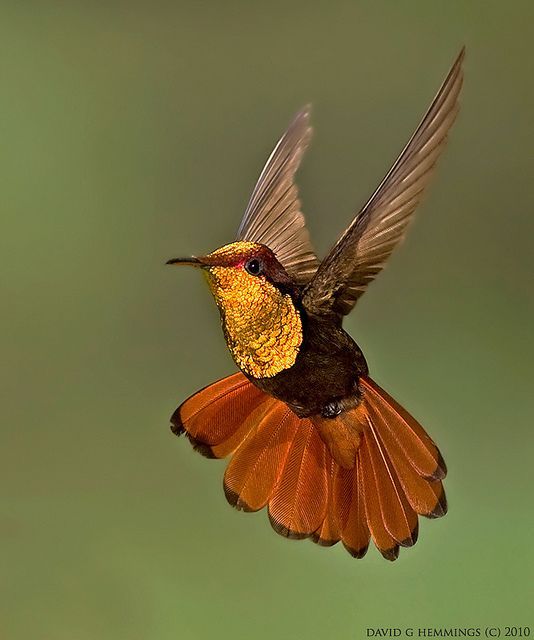
Picture 1: Ruby Topaz Hummingbird (Chrysolampis mosquitus)

The ruby-topaz hummingbird (Chrysolampis mosquitus), commonly referred to simply as the ruby topaz, is a species of hummingbird in the subfamily Polytminae, the mangoes. It is found in Aruba, Bolivia, Bonaire, Brazil, Colombia, Curaçao, French Guiana, Guyana, Panama, Suriname, Trinidad and Tobago, and Venezuela.

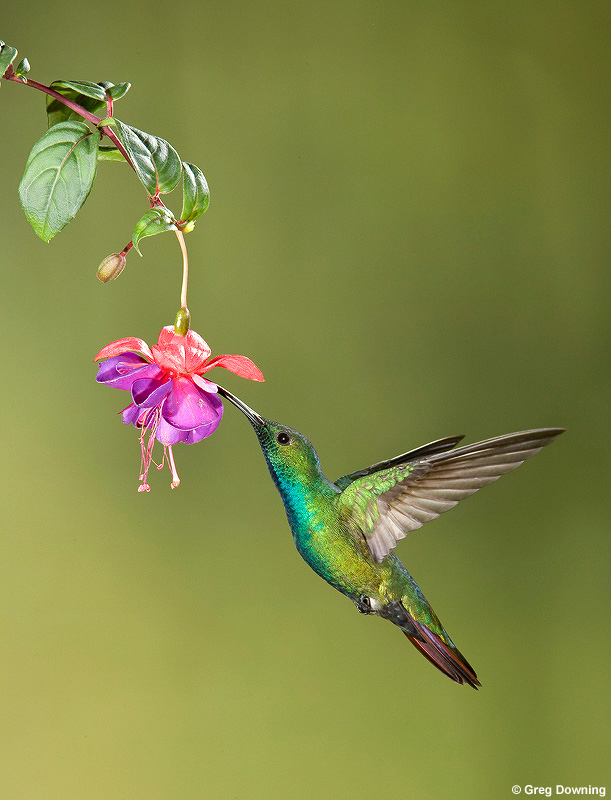
Picture 2: Green-breasted mango (Anthracothorax prevostii) 

The green-breasted mango or Prevost’s mango (Anthracothorax prevostii) is a species in subfamily Polytminae of the hummingbird family Trochilidae. It is found from eastern Mexico south through most of Central America, in Colombia and Venezuela, and as a vagrant in the United States.

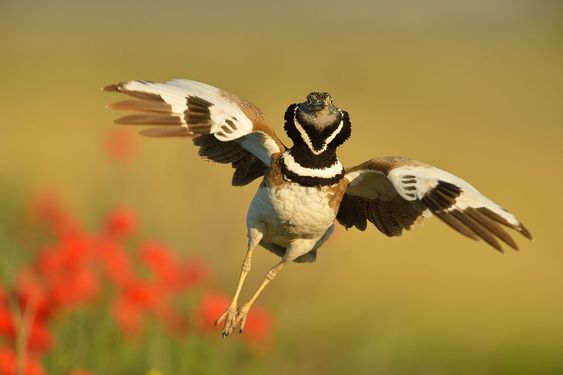
Picture 3: Little bustard (Tetrax tetrax)

The little bustard (Tetrax tetrax) is a bird in the bustard family, the only member of the genus Tetrax. The genus name is from Ancient Greek and refers to a gamebird mentioned by Aristophanes and others.

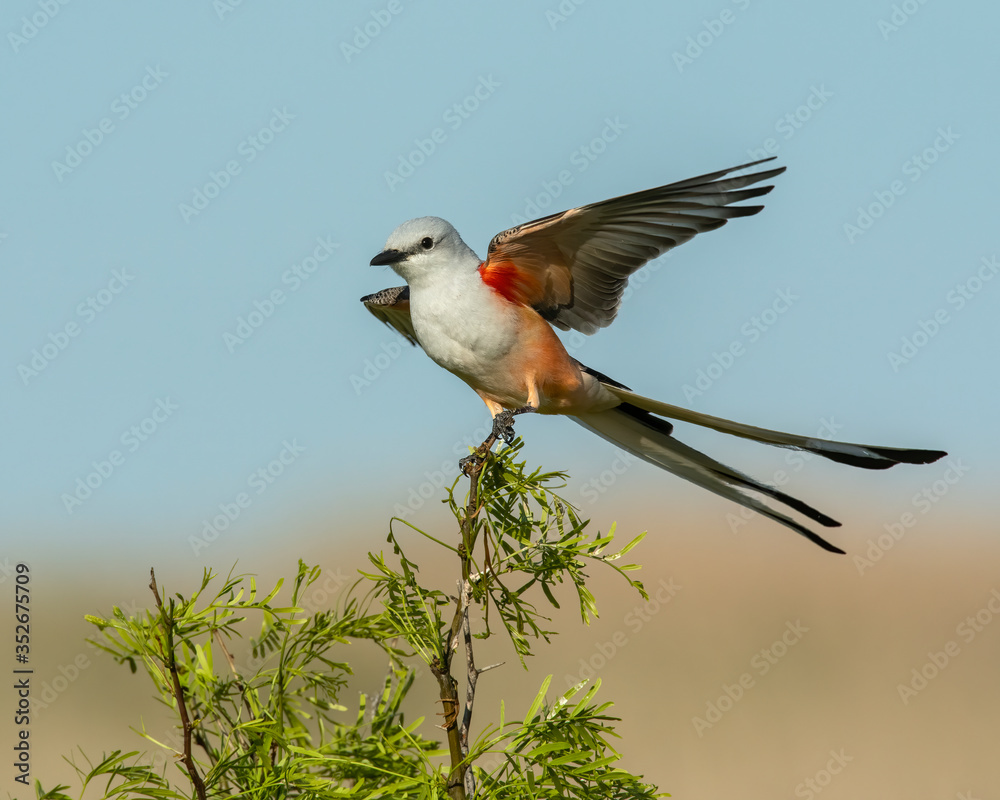
Picture 4: Tyrannus forficatus (Tyrannidae)

The scissor-tailed flycatcher (Tyrannus forficatus), also known as the Texas bird-of-paradise and swallow-tailed flycatcher, is a long-tailed insectivorous bird of the genus Tyrannus, whose members are collectively referred to as kingbirds. It is is found in North and Central America.

Scissortail Flycatcher

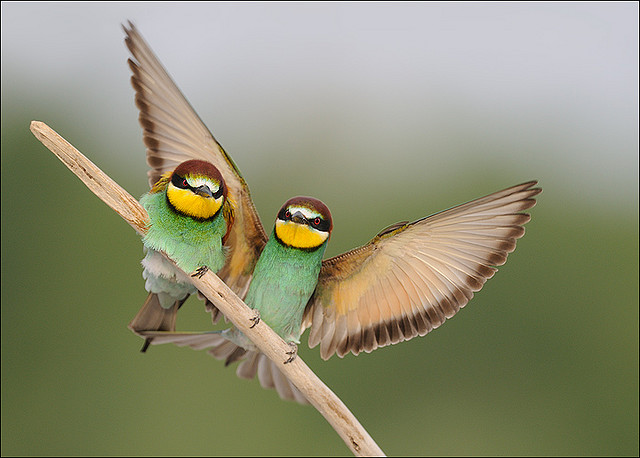
Picture 5: European bee-eater (Merops apiaster)

The European bee-eater (Merops apiaster) is a near passerine bird in the bee-eater family, Meropidae. It breeds in southern and central Europe, northern and southern Africa, and western Asia. Except for the resident southern African population, the species is strongly migratory, wintering in tropical Africa. This species occurs as a spring overshoot north of its usual range, with occasional breeding in northern Europe.

PSD Collector: Bird Photography : 30 Remarkable Photographs

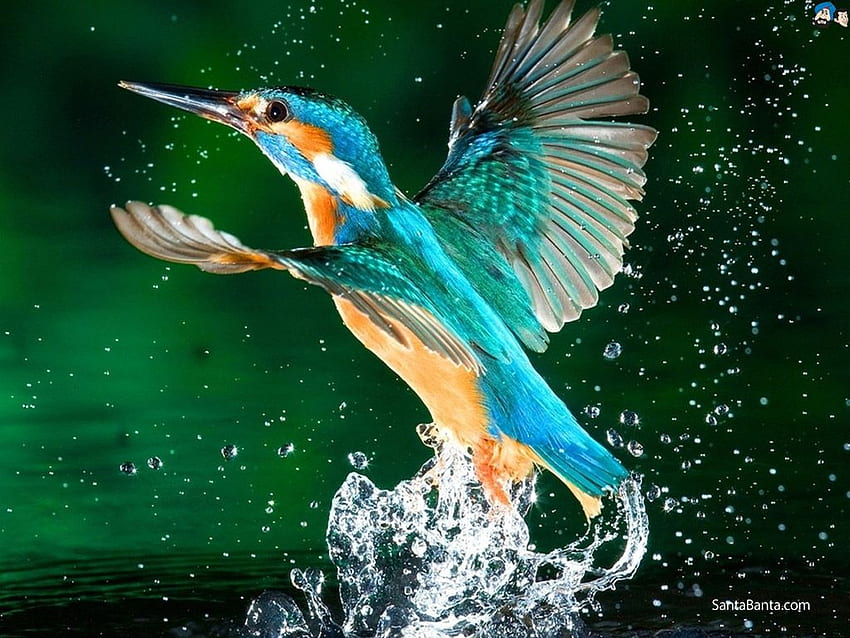
Picture 6: Kingfisher ( Coraciiformes)

Kingfishers are a family, the Alcedinidae, of small to medium-sized, brightly colored birds in the order Coraciiformes. They have a cosmopolitan distribution, with most species found in the tropical regions of Africa, Asia, and Oceania, but also can be seen in Europe. They can be found in deep forests near calm ponds and small rivers. The family contains 116 species and is divided into three subfamilies and 19 genera. All kingfishers have large heads, long, sharp, pointed bills, short legs, and stubby tails. Most species have bright plumage with only small differences between the sexes. Most species are tropical in distribution, and a slight majority are found only in forests.

Beautiful bird full HD wallpapers | Pxfuel

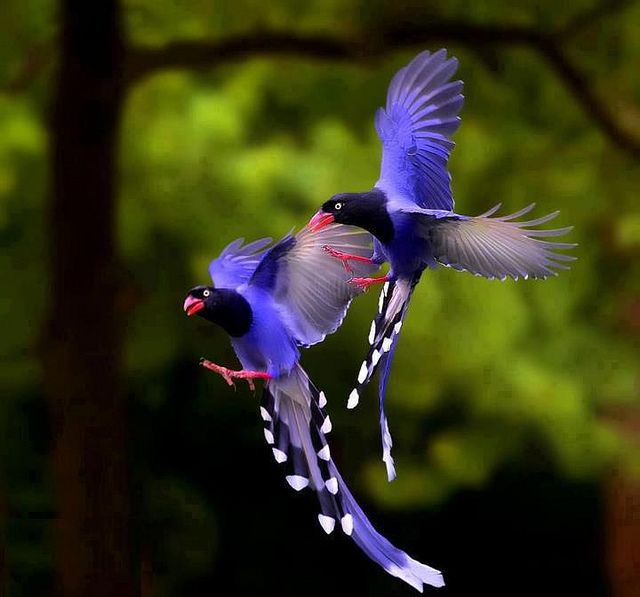
Picture 7: Urocissa erythroryncha (Corvidae)

The red-billed blue magpie (Urocissa erythroryncha) is a species of bird in the crow family, Corvidae. It is about the same size as the Eurasian magpie, but has a much longer tail, one of the longest of any corvid. It is 65–68 cm (25.5–27 in) long and weighs 196–232 g (6.9–8.2 oz).

GOD CREATURES | Beautiful birds, Colorful birds, Wild birds

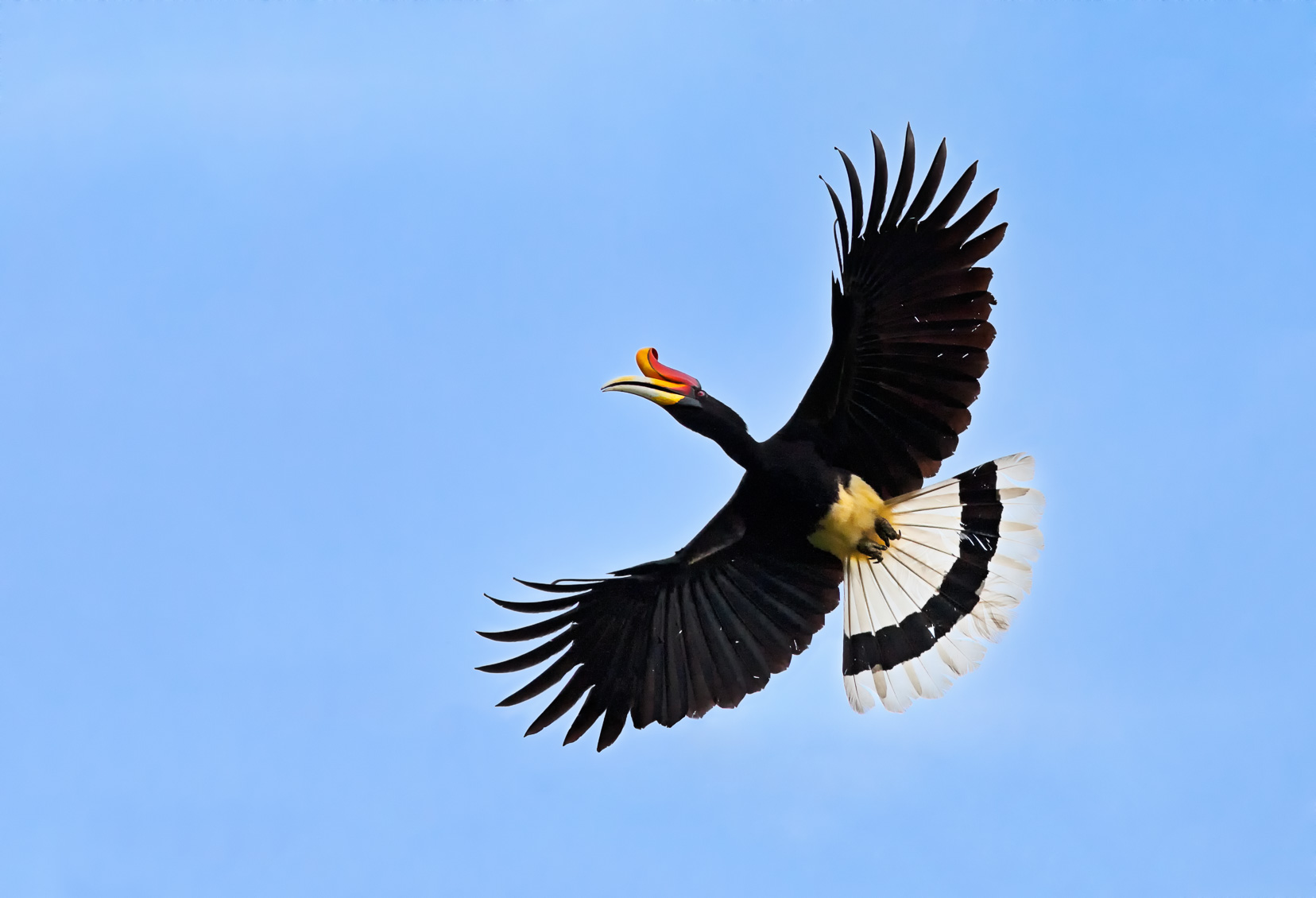
Picture 8: Rhinoceros Hornbill ((Bucerotidae)

The rhinoceros hornbill (Buceros rhinoceros) is a large species of forest hornbill (Bucerotidae). In captivity it can live for up to 35 years. It is found in lowland and montane, tropical and subtropical climates and in mountain rain forests up to 1,400 metres in Borneo, Sumatra, Java, the Malay Peninsula, Singapore, and southern Thailand.[1]

The rhinoceros hornbill is the state bird of the Malaysian state of Sarawak and the country’s national bird.[3] Some Dayak people, especially the Ibanic groups, believe it to be the chief of worldly birds or the supreme worldly bird, and its statue is used to welcome the god of the augural birds, Sengalang Burong, to the feasts and celebrations of humankind. Contrary to some misunderstandings, the rhinoceros hornbill does not represent their war god, who is represented in this world by the brahminy kite.[4][5] It is featured on the reverse of the 5 Malaysian ringgit bill.

Rhinoceros Hornbill In Flight • Bird Photography Prints For Sale

Picture 9: Icterus galbula (Icteridae)

The Baltimore oriole (Icterus galbula) is a small icterid blackbird common in eastern North America as a migratory breeding bird. It received its name from the resemblance of the male’s colors to those on the coat-of-arms of 17th century Lord Baltimore. Observations of interbreeding between the Baltimore oriole and the western Bullock’s oriole, Icterus bullockii, led to both being classified as a single species, called the northern oriole, from 1973 to 1995. Research by James Rising, a professor of zoology at the University of Toronto, and others showed that the two birds actually did not interbreed significantly.

The Baltimore oriole is the state bird of Maryland. It is also the namesake and mascot for the Baltimore Orioles baseball team.

This Week in Science | Science

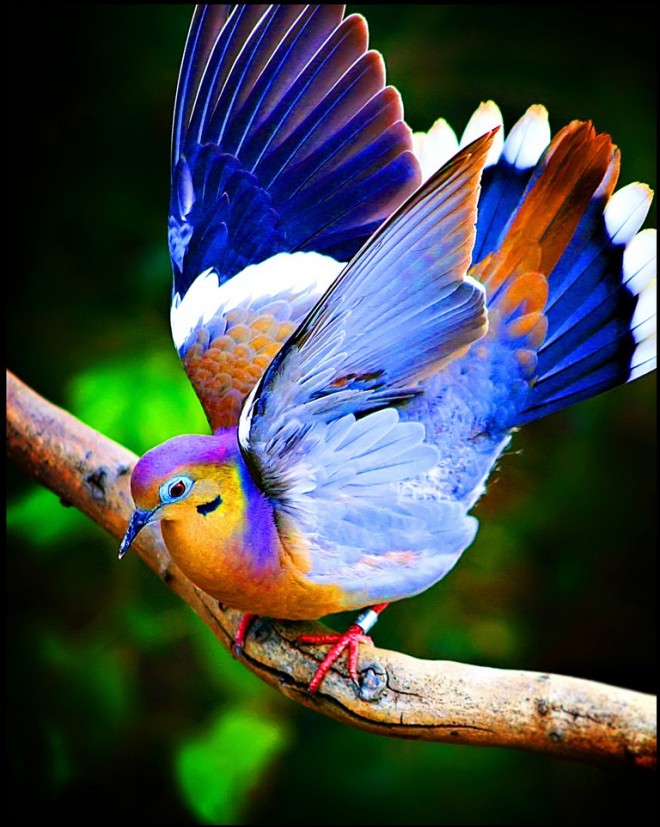
Picture 10: superb fruit dove (Ptilinopus superbus)

The superb fruit dove (Ptilinopus superbus), also known as the purple-crowned fruit dove (leading to easy confusion with the purple-capped fruit dove), is a medium-sized (22–24 cm long), colourful fruit-dove in the family Columbidae.

25 Most Beautiful Bird Photography examples and Tips for photographers

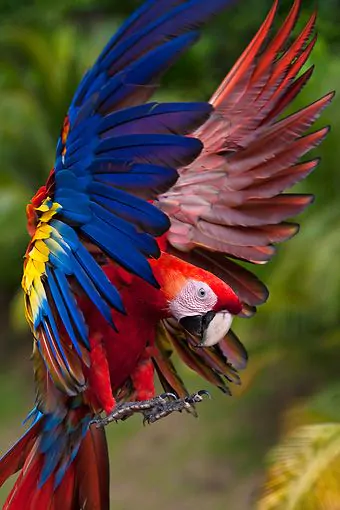
Picture 11: Scarlet Macaw (Neotropical parrots)

The scarlet macaw (Ara macao) is a large yellow, red and blue Central and South American parrot, a member of a large group of Neotropical parrots called macaws. It is native to humid evergreen forests of the Neotropics. Its range extends from south-eastern Mexico to Peru, Ecuador, Colombia, Bolivia, Venezuela and Brazil in lowlands of 500 m (1,600 ft) (at least formerly) up to 1,000 m (3,300 ft), the Caribbean island of Trinidad, as well as the Pacific island of Coiba.[1] Formerly, the northern extent of its range included southern Tamaulipas. In some areas, it has suffered local extinction because of habitat destruction, or capture for the parrot trade, but in other areas, it remains fairly common. It is the national bird of Honduras. Like its relative the blue-and-yellow macaw, the scarlet macaw is a popular bird in aviculture as a result of its striking plumage.

SCARLET

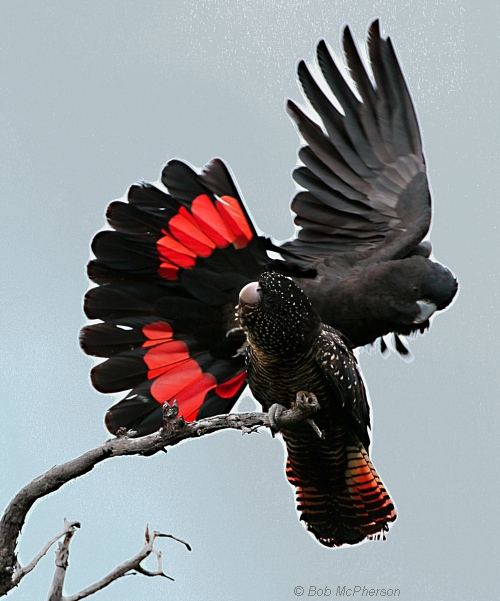
Picture 12: Red-tailed black cockatoo (Calyptorhynchus banksii)

The red-tailed black cockatoo (Calyptorhynchus banksii) also known as Banksian- or Banks’ black cockatoo, is a large black cockatoo native to Australia. Adult males have a characteristic pair of bright red panels on the tail that gives the species its name. It is more common in the drier parts of the continent. Five subspecies are recognised, differing chiefly in beak size. Although the more northerly subspecies are widespread, the two southern subspecies, the forest red-tailed black cockatoo and the south-eastern red-tailed black cockatoo are under threat.

The species is usually found in eucalyptus woodlands, or along water courses. In the more northerly parts of the country, these cockatoos are commonly seen in large flocks. They are seed eaters and cavity nesters, and as such depend on trees with fairly large diameters, generally Eucalyptus. Populations in southeastern Australia are threatened by deforestation and other habitat alterations. Of the black cockatoos, the red-tailed is the most adaptable to aviculture, although black cockatoos are much rarer and much more expensive in aviculture outside Australia.

Red-tailed Black-Cockatoo

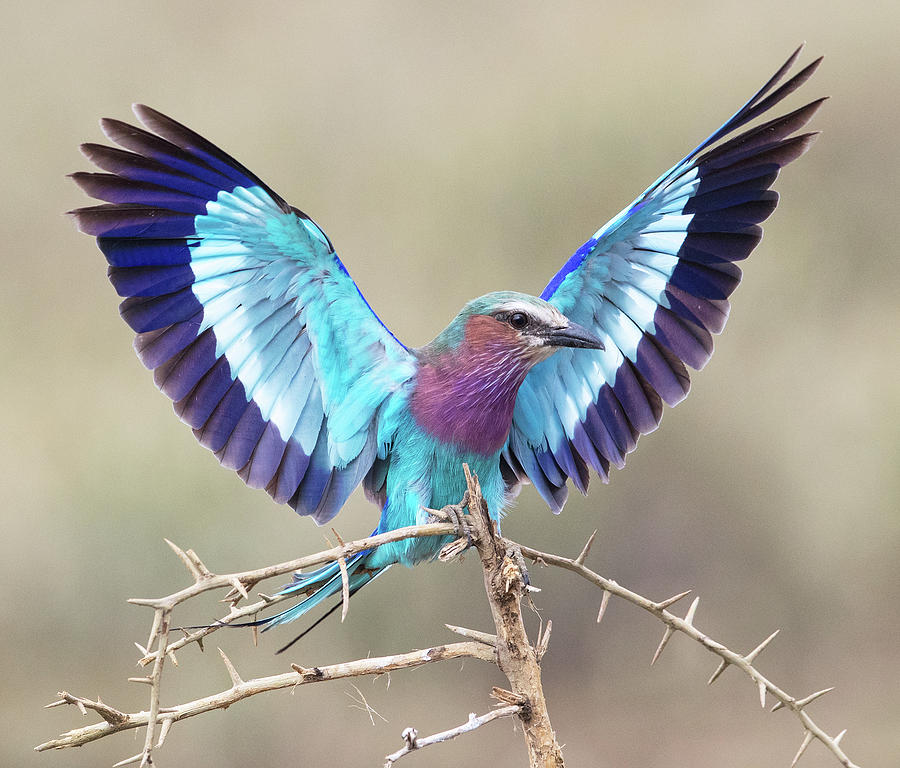
Picture 13: The lilac-breasted roller (Coracias caudatus) 

The lilac-breasted roller (Coracias caudatus) is an African bird of the roller family, Coraciidae. It is widely distributed in Southern and Eastern Africa, and is a vagrant to the southern Arabian Peninsula.[1] It prefers open woodland and savanna, and it is for the most part absent from treeless places. Usually found alone or in pairs, it perches at the tops of trees, poles or other high vantage points from where it can spot insects, amphibians and small birds moving about on the ground.[2] Nesting takes place in a natural hole in a tree where a clutch of 2–4 eggs are laid, and incubated by both parents, who are extremely aggressive in defence of their nest, taking on raptors and other birds. During the breeding season the male will rise to a fair height (69 to 144 metres), descending in swoops and dives,[3] while uttering harsh, discordant cries. The sexes are different in coloration, and juveniles lack the long tail streamers of adults. This species is unofficially considered the national bird of Kenya. Alternative names for the lilac-breasted roller include the fork-tailed roller, lilac-throated roller (also used for a subspecies of purple roller) and Mosilikatze’s roller.

Nature Photograph - Lilac-Breasted Roller by Max Waugh

Picture 14:  Atlantic puffin  (Fratercula arctica)

The Atlantic puffin (Fratercula arctica), also known as the common puffin, is a species of seabird in the auk family. It is the only puffin native to the Atlantic Ocean; two related species, the tufted puffin and the horned puffin are found in the northeastern Pacific. The Atlantic puffin breeds in Russia, Iceland, Ireland, Norway, Greenland, Newfoundland and Labrador, Nova Scotia, and the Faroe Islands, and as far south as Maine in the west and France in the east. It is most commonly found in the Westman Islands, Iceland. Although it has a large population and a wide range, the species has declined rapidly, at least in parts of its range, resulting in it being rated as vulnerable by the IUCN. On land, it has the typical upright stance of an auk. At sea, it swims on the surface and feeds on small fish and crabs, which it catches by diving underwater, using its wings for propulsion.

This puffin has a black crown and back, pale grey cheek patches, and a white body and underparts. Its broad, boldly marked red-and-black beak and orange legs contrast with its plumage. It moults while at sea in the winter, and some of the brightly coloured facial characteristics are lost, with colour returning during the spring. The external appearances of the adult male and female are identical, though the male is usually slightly larger. The juvenile has similar plumage, but its cheek patches are dark grey. The juvenile does not have brightly coloured head ornamentation, its bill is narrower and is dark grey with a yellowish-brown tip, and its legs and feet are also dark. Puffins from northern populations are typically larger than in the south and these populations are generally considered a different subspecies.

Spending the autumn and winter in the open ocean of the cold northern seas, the Atlantic puffin returns to coastal areas at the start of the breeding season in late spring. It nests in clifftop colonies, digging a burrow in which a single white egg is laid. Chicks mostly feed on whole fish and grow rapidly. After about 6 weeks, they are fully fledged and make their way at night to the sea. They swim away from the shore and do not return to land for several years.

Colonies are mostly on islands with no terrestrial predators, but adult birds and newly fledged chicks are at risk of attacks from the air by gulls and skuas. Sometimes, a bird such as an Arctic skua or blackback gull can cause a puffin arriving with a beak full of fish to drop all the fish the puffin was holding in its mouth. The puffin’s striking appearance, large, colourful bill, waddling gait, and behaviour have given rise to nicknames such as “clown of the sea” and “sea parrot”. It is the official bird of the Canadian province of Newfoundland and Labrador.

The Bird Photographer of the Year 2021

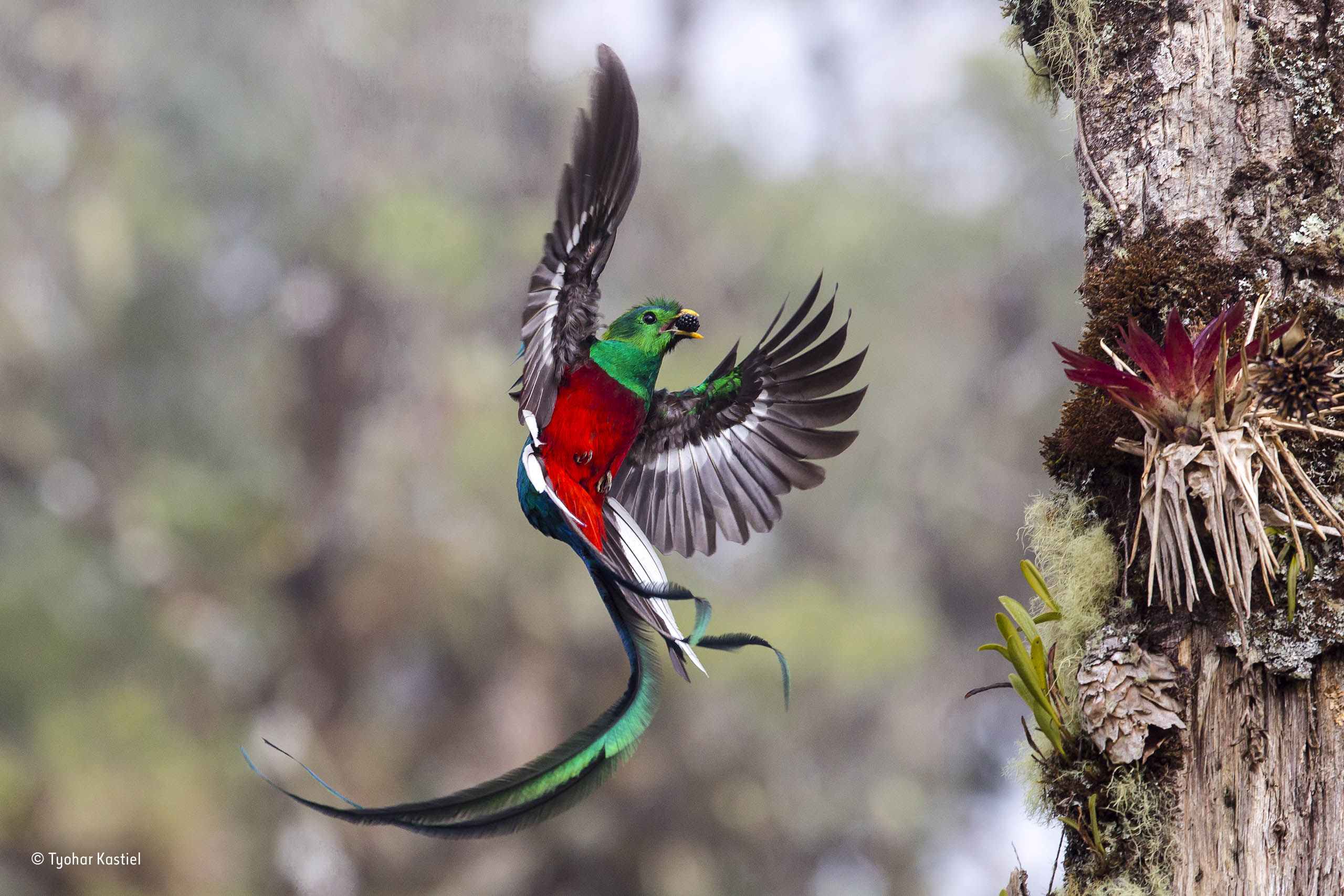
Picture 15: Resplendent quetzal (Pharomachrus mocinno)

The resplendent quetzal (Pharomachrus mocinno) is a small bird found in southern Mexico and Central America that lives in tropical forests, particularly montane cloud forests. They are part of the family Trogonidae and have two recognized subspecies, P. m. mocinno and P. m. costaricensis. Like other quetzals, the resplendent is mostly omnivorous; its diet mainly consists of fruits of plants in the laurel family, Lauraceae, but it occasionally also preys on insects, lizards, frogs and snails.

The species is well known for its colorful and complex plumage that differs substantially between sexes. Males have iridescent green plumes, a red lower breast and belly, black innerwings and a white undertail, whilst females are duller and have a shorter tail. Grey lower breasts, bellies, and bills, along with bronze-green heads are characteristic of females. These birds hollow holes in decaying trees or use ones already made by woodpeckers as a nest site. They are known to take turns while incubating, males throughout the day and females at night. The female usually lays one to three eggs, which hatch in 17 to 19 days. The quetzal is an altitudinal migrant, migrating from the slopes to the canopy of the forest. This occurs during the breeding season, which varies depending on the location, but usually commences in March and extends as far as August.

The resplendent quetzal is considered near threatened on the IUCN Red List, with habitat destruction being the main threat. It has an important role in Mesoamerican mythology, and is closely associated with Quetzalcoatl. Presently, it is the national animal of Guatemala, being pictured on the flag and coat of arms; it also gives its name to the country’s currency, the Guatemalan quetzal.

Resplendent delivery | Wildlife Photographer of the Year | Natural History Museum

On July 8, 1947, the US document Memorandum 6751 was declassified and made public by the FBI archives, which acknowledges the presence of extraterrestrial life. This memorandum is cited as a significant work of ufology literature in “The Extra-Dimensionals: True Tales and Concepts of Alien Visitors,” written by former FBI agent John DeSouza.

The book mentions that the memorandum warns of a potential crisis involving flying saucers, which could cause panic and mistrust of aliens among the public.

The author of the material also claims that the operation of flying saucers involves both remotely operated and piloted discs. Additionally, the book states that despite having a benevolent purpose, these UFOs have the ability to defend themselves against human weaponry in various ways.

According to the narrative, travelers are human-like but much larger beings that ride “planes” resembling discs and are powered by some type of radiant energy or lightning that can instantly annihilate any invader.

An anonymous professor claims that the aliens may enter the etheric body at will and vanish from human sight due to their unmatched agility.

Although a lot of the information in this text is extremely thorough, there are some inconsistencies.

First, the author’s identity is not made clear, despite the fact that he asserts to have a long list of credentials and to have run a university department. Another element that needs to be considered is the fact that the FBI developed the document, not someone else.

Contrary to early Roswell claims, this file mentions “living things far larger than humans.” They also supposedly have the capacity to live in different dimensions or realms.

The article’s author, however, never explained how he gathered all the data. Everything in Memorandum 6751 is unclear after this point.

Unfortunately, the remaining 66 pages are not available. News portal Film Daily, in turn, reported about another fascinating discovery, which is related, although not documented.

Allegedly, 10 years ago, the FBI declassified the 70-page document and placed it in The Vault. The publication assured that the data was declassified in 2010. NASA and other space agencies have been hesitant to consider anomalies or artificial structures in spaceflight as potentially extraterrestrial, but astronomer Avi Loeb disagrees. He believes that science should not be influenced by social stigma or cultural bias that prevents unbiased empirical research.

Therefore, Loeb advocates for the use of new telescopes, both literally and figuratively, to explore the possibility of alien life. He is leading the Galileo project, which aims to modernize existing telescopes to search for evidence of extraterrestrial life.